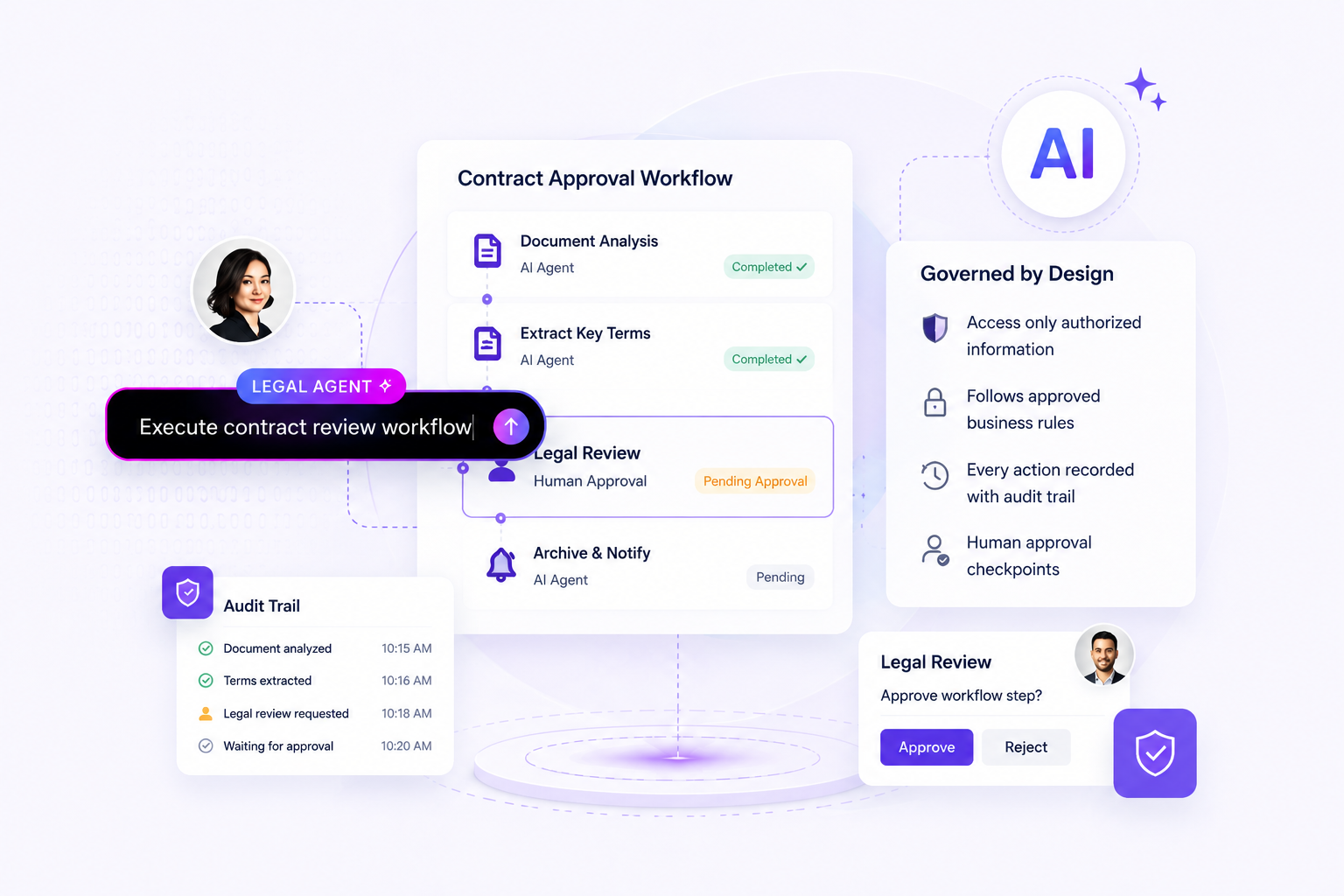
Drive enterprise transformation with
Agentic Workflow
AI-powered workflows that adapt, make decisions, and keep work moving.
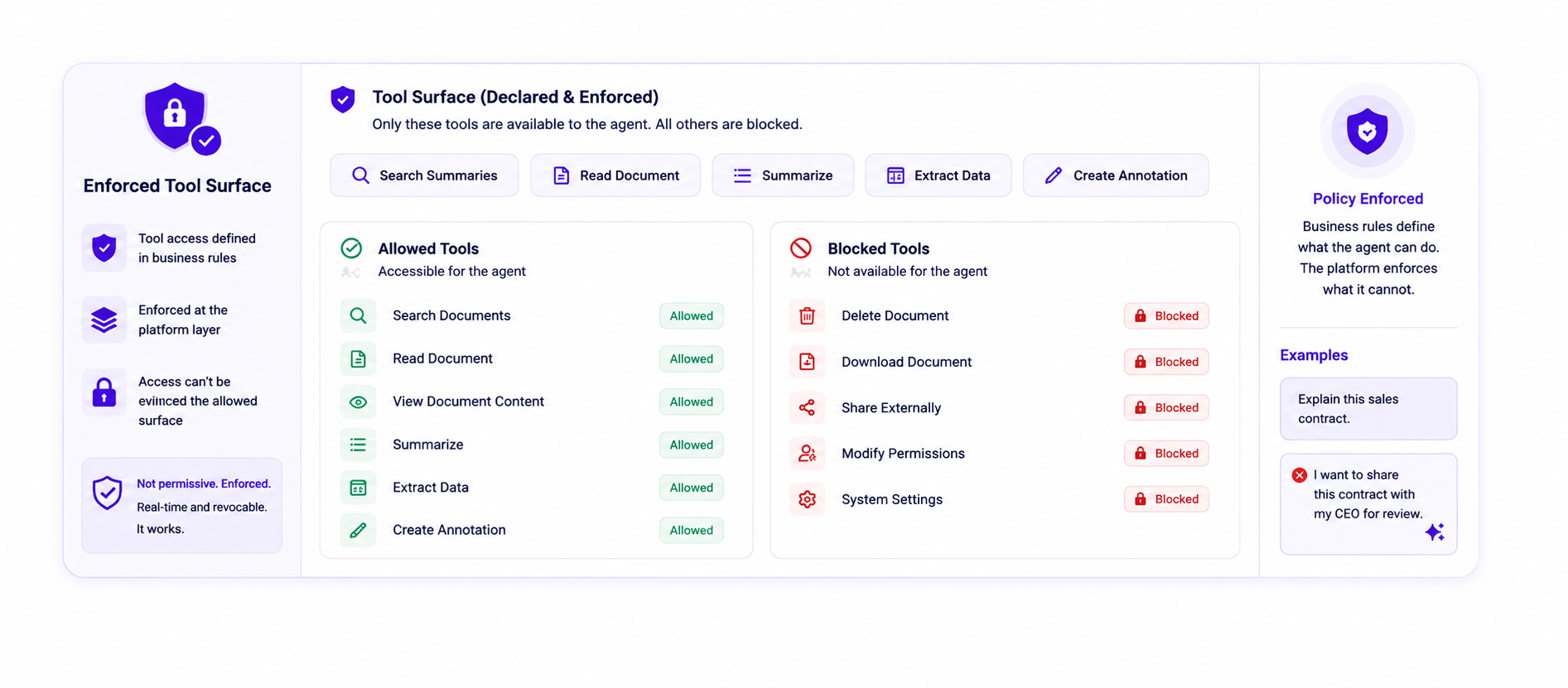
Enforced Tool Surface
Prompt engineering keeps an agent in line for a demo, not for a regulator's review. TeamSync declares the tool surface in business rules, enforced at the platform layer. The agent can't act outside it, those actions simply aren't reachable
Where Autonomous AI Meets Governance
90% faster first-pass processing
Claims triage, contract first-pass review, quality event routing — the agent handles the classification and routing; the human handles the judgment. Cycle times collapse
The agent cannot exceed its authority
Tool surface enforcement is structural. No prompt can override a business rule. The auditor's question — "what was the agent allowed to do?" — has a declarative answer
EU AI Act compliant by design
Every action anchored. Every refusal anchored. Human oversight evidence generated from the chain. The high-risk-system documentation is a query, not a project
How Enterprises Use TeamSync Every Day
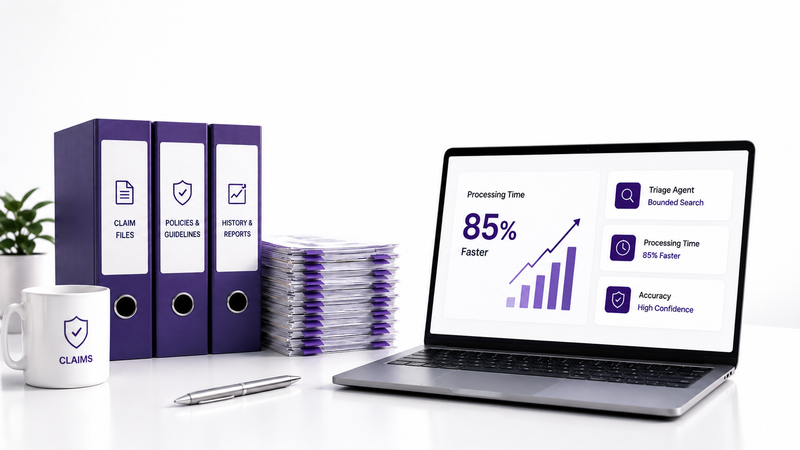
Claims team processes 85% faster with bounded triage agent
The agent reads incoming claims, classifies against the taxonomy, routes to the correct handler, and escalates above defined value thresholds. Every action anchored. Human reviewers focus on edge cases.

Credentialing team cuts cycle time by 4x with document agent
The agent collects credentialing documents, checks completeness against the required checklist, and flags missing items for follow-up — without requiring the credentialing officer to track each case manually.

Contract first-pass review from days to hours
The agent flags risk clauses against the playbook, summarises key terms, and routes high-risk contracts to senior review — with every classification anchored and defensible.
Agentic AI Workflow FAQs.
Let's clear things up.
We know — AI agents, autonomy limits and approval gates can feel overwhelming. TeamSync brings them into one governed experience.
Whether an agent is routing invoices or drafting a response, we are here to make its behaviour visible, bounded and easy to audit.
An agent reads a document, decides what it is, and takes the next step itself rather than waiting for a person to trigger each stage. In TeamSync the actions it may take are declared in business rules and enforced at the platform layer, so autonomy is bounded by configuration, not by prompt wording.
A rule fires on a fixed condition you defined in advance. An agent classifies ambiguous input and chooses a path, then hands anything above your defined thresholds to a person. The rules do not disappear - they become the boundary the agent operates inside.
That depends on your use case, not on the platform. Where a deployment does fall in scope, every agent action and refusal is anchored to the audit chain and human-oversight evidence is generated from it, so the required documentation is a query rather than a project.
Agent actions are versioned like any other change, so a document or workflow state can be restored to the point before the agent acted, and the audit chain records the inputs, the rule that fired and the outcome.
Agents are configured in the workflow designer from document types, metadata and rules you already have. Custom code is optional rather than required, so the constraint is usually how quickly your rules can be agreed, not build time.
30 minutes with a solutions engineer who already speaks your industry.
No pitch deck. We will either show you a clear path forward or tell you we are not the right fit. Bring the toughest question on your desk this week.