On this page
- What financial crime compliance means
- Financial crime, AML, sanctions and fraud
- Who regulates what: FinCEN, OFAC, FCA and FATF
- The pillars of an AML compliance program
- Designated compliance officer
- Internal policies, procedures and controls
- Ongoing training
- Independent testing and audit
- Customer due diligence and beneficial ownership
- Customer onboarding and KYC
- Risk rating and segmentation
- Enhanced due diligence triggers
- Sanctions and PEP screening
- Transaction monitoring and alert handling
- SAR decisioning and filing
- Recordkeeping and retention
- Independent testing
- Common examination findings
- See how we help regulated teams keep every FCC document, workflow and audit trail in one place
Roughly $3.1 trillion in illicit funds moved through the global financial system in 2023, while global scam losses reached about $485.6 billion. In the U.S., the FBI’s IC3 logged 880,418 complaints with reported losses above $12.5 billion for 2023, then reported more than $16 billion in losses in its next annual release. FinCEN’s own FY 2024 data shows the operational scale behind those risks: about 4.7 million SARs and 20.5 million CTRs filed in a single fiscal year.
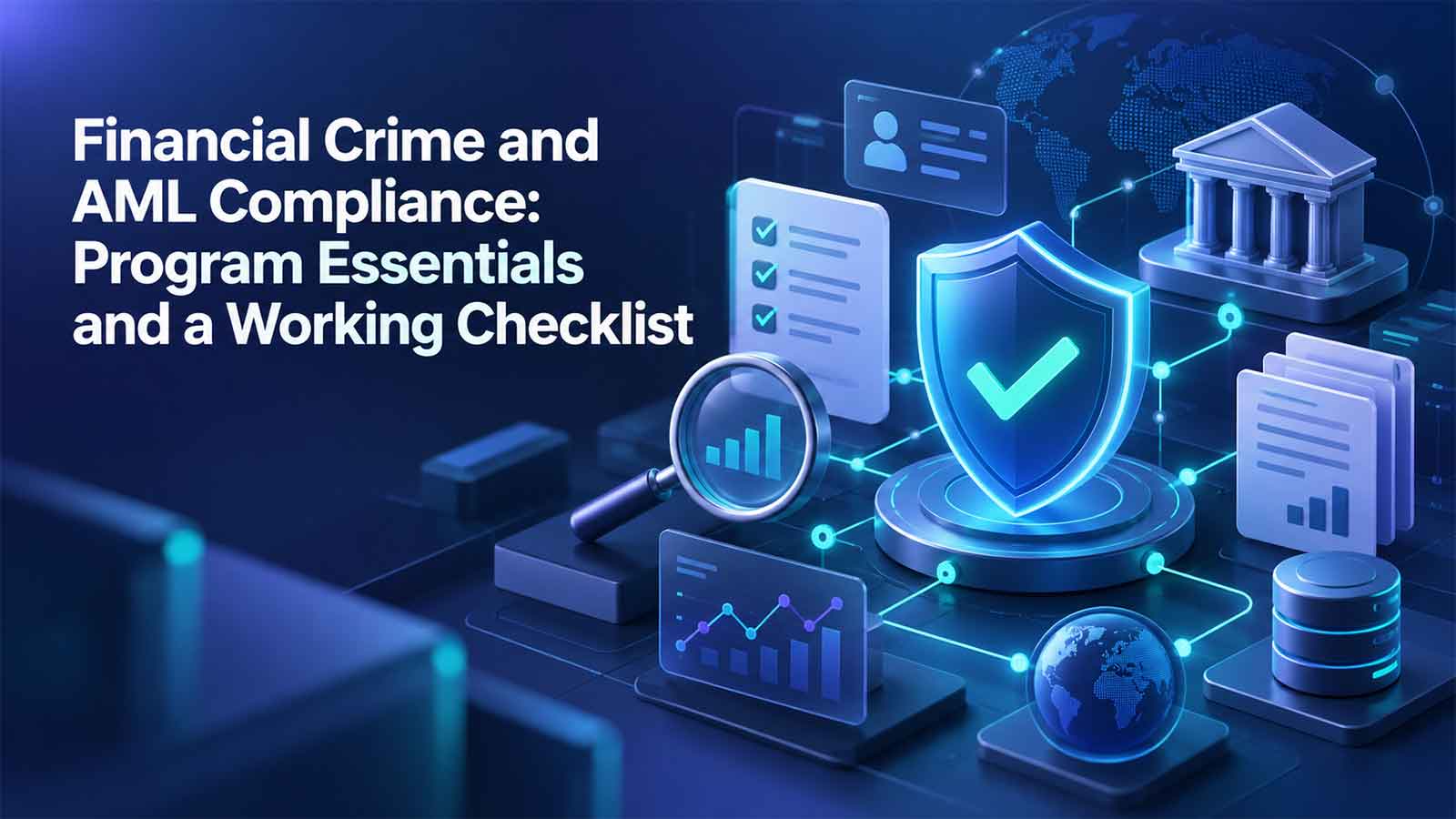
Financial crime compliance helps organizations prevent, detect, investigate, and report risks like money laundering, fraud, and sanctions violations. This guide explores the essentials of an AML compliance program, key compliance controls, and how TeamSync helps compliance teams centralize KYC records, investigations, policies, and audit-ready documentation in one secure system.
What financial crime compliance means
Financial crime compliance is the governance, controls, reporting and recordkeeping framework a firm uses to prevent, detect, investigate and report exposure to illicit finance. It is the operating system behind how a regulated business handles money laundering risk, terrorist financing, sanctions exposure, fraud risk and the evidence trail that regulators expect to see later. In U.S. practice, that umbrella sits over BSA/AML duties, sanctions compliance and connected fraud controls. Global teams will also recognize the influence of FATF standards and UK FCA expectations.
The purpose is not just to stop bad actors at the door. A working financial crime compliance program also protects the institution from preventable loss, enforcement exposure, reputational damage and weak decision making caused by poor records. That is why prevention, detection, mitigation and defensibility all matter at the same time.
Financial crime, AML, sanctions and fraud
AML focuses on detecting and reporting suspicious activity tied to money laundering and terrorist financing under the Bank Secrecy Act framework. Sanctions compliance focuses on screening parties, payments and ownership structures against OFAC restrictions. Fraud programs target scams, account takeover, synthetic identity, mule activity and payment abuse. Financial crime compliance ties those disciplines together through shared governance, investigations, escalation paths, regulatory reporting and documentation.
One case can touch all four. A new LLC is onboarded through a fast digital channel. The beneficial ownership story is thin, the account starts receiving victim-funded instant payments, one counterparty resembles a sanctioned alias and the customer quickly pushes funds to a crypto off-ramp. Fraud sees mule behavior. Sanctions sees a screening issue. AML sees suspicious movement of funds. Financial crime compliance is what makes sure those teams do not reach four different conclusions in four different systems.
Who regulates what: FinCEN, OFAC, FCA and FATF
FinCEN administers the BSA reporting framework, oversees SAR and CTR architecture and drives AML rulemaking including CDD requirements. OFAC administers U.S. sanctions programs and its compliance framework overlaps with AML whenever customer, payment or ownership reviews raise blocked-party risk. FATF is the global standard setter.
Its Recommendations shape local regimes, supervisory expectations and mutual evaluations across jurisdictions. The FCA matters mainly for multinational readers because its financial crime systems-and-controls guidance and MLRO expectations often appear in group policy design. On top of that, U.S. prudential regulators, the FFIEC examination framework and state banking or money transmission regulators shape what “good” looks like in practice. The EU is moving too, with its 2024 AML package and AMLA now taking over EU-level AML/CFT responsibilities from the EBA beginning January 1, 2026.
The pillars of an AML compliance program
In the U.S., teams often talk about the “pillars” of AML even when exact wording varies by institution type. In practice, examiners want to see the same core elements working together: named accountability, written controls, training, independent testing and customer due diligence.
Designated compliance officer. A real owner with authority to escalate, report to senior management or the board, track issues and keep the program current.
Internal policies, procedures and controls. Not just a policy PDF, but procedures, typologies, control inventory, scenario governance, approval records and exception handling that match actual operations.
Ongoing training. Onboarding training, annual refreshers and role-based sessions for frontline teams, investigators, QA, product teams and executives with attestations that can be produced later.
Independent testing and audit. Separate review of design and operating effectiveness, issue ratings, remediation tracking and retesting beyond first-line QA.
Customer due diligence. CIP, customer risk profiling, beneficial ownership where applicable, EDD triggers and ongoing refresh that feeds screening, monitoring and investigations.
Designated compliance officer
A BSA or AML officer without decision authority is a title, not a control. The role needs escalation rights, direct visibility into material issues, a documented reporting line and ownership over risk assessments, board packs and remediation tracking. One common failure point is fragmented oversight where fraud, sanctions and AML each close their own issues but nobody owns the combined risk picture.
Internal policies, procedures and controls
The policy stack should run from enterprise policy down to frontline procedures. That includes product and geographic risk typologies, an inventory of key controls, scenario ownership, change governance, escalation matrices and approval history. Examiners do not stop at the policy binder. They compare the written procedure to actual alert handling, case documentation and exception approvals. That is where gaps show up.
Ongoing training
Training works best when it mirrors role-specific risk. Frontline teams need CIP and escalation basics. Investigators need note standards, SAR support practices and typology updates. QA and audit teams need testing criteria. Executives need trend reporting and governance duties. Weak exam files usually show the same pattern: stale content, attendance logs without attestation or no proof that higher-risk teams completed targeted refreshers.
Independent testing and audit
Independent testing is not the same as first-line QA. QA asks whether analysts followed today’s workflow. Independent testing asks whether the control design is sound, whether it operated effectively across a sample and whether issues were rated, assigned, remediated and retested. Internal audit becomes the third line when it validates that management’s fixes are real and exam-ready.
Customer due diligence and beneficial ownership
CIP and CDD remain the foundation. Covered institutions still need enough customer information to build a risk profile, support sanctions screening and make transaction monitoring useful. Beneficial ownership is still a live operational issue even after recent BOI rule changes. FinCEN’s BOI access rule took effect on February 20, 2024, BOI reporting rules changed in March 2025 and again on August 14, 2026 and FinCEN’s February 13, 2026 CDD relief changed when covered institutions must repeat beneficial ownership collection at new account opening. The practical takeaway is simple: your procedures need current dates, clear triggers and evidence that staff followed the version in force at the time.
Customer onboarding and KYC
Your onboarding controls should prove that CIP was completed, identity was verified using documentary or non-documentary methods, required fields were captured, a customer risk score was assigned and exceptions were explicitly approved. Good evidence looks boring in the best way: complete opening checklists, linked ID artifacts and timestamps that show who approved what and when.
Risk rating and segmentation
A risk score is only useful if the methodology is documented and explainable. Customer segmentation should reflect product risk, geographic exposure, channel risk and behavior change triggers. When scoring is automated, keep the segmentation logic and model-change record. That is how you defend why one customer went into standard due diligence while another went into EDD. The dashboard we recommend tracking at this stage is simple: alert-to-case conversion, false-positive rate, median alert age, SAR filing timeliness, screening hit quality, KYC refresh backlog and investigator QA defect rate.
Enhanced due diligence triggers
EDD should not depend on analyst instinct alone. Define triggers for higher-risk customers, unusual ownership structures, source-of-funds or source-of-wealth review, adverse media, politically exposed persons where relevant, high-risk jurisdictions and behavior that no longer fits the original customer profile. Evidence should include the questionnaire used, the documents gathered, the escalation notes and the approval record that allowed the relationship to proceed.
Sanctions and PEP screening
OFAC screening belongs at onboarding, during periodic refresh and whenever a customer, owner or counterparty changes. Good programs also track list management, alias handling, ownership screening and clear disposition standards so analysts do not resolve one possible hit three different ways. PEP screening is not the same as sanctions screening, but many firms manage both in the same workflow because the evidence chain is similar.
Transaction monitoring and alert handling
This is where fast payments and new fraud typologies change the workload. Scenario inventories need owners. Threshold changes need governance. Data source mapping needs to be documented. Alert queues need service levels, note standards and closure rules that survive QA. Recent official alerts point to exactly where scenarios need updating: deepfake-enabled fraud, overseas digital-asset scam centers, Chinese money laundering networks, mule activity and instant-payment fraud controls. For payment processors and instant-payments businesses, event-driven monitoring matters more because the window to stop loss is shorter. For crypto exposure, wallet and off-ramp context matters because fraudulent proceeds often move across both fiat and digital rails.
SAR decisioning and filing
A defensible SAR process has a clear escalation path, named reviewers, consistent narrative standards, linked support files, confidentiality controls and a rule for post-filing monitoring. Whether you use a committee or a single reviewer matters less than whether the case file shows how the decision was reached and whether the filing package can be reproduced quickly when requested.
Recordkeeping and retention
Many U.S. AML retention duties cluster around five-year periods, but exact rules vary by record type and institution. As a practical cheat sheet, teams often align CIP records, BSA report support and related investigation materials to those minimums, while keeping policy archives, training logs and testing reports long enough to cover the full exam cycle plus any open issue or legal hold. Confirm those periods with counsel and your regulator because the mix changes by charter and business line.
Independent testing
Testing should follow an annual or risk-based plan, show sample coverage, assign issue owners, set remediation due dates and include retesting evidence. Open findings need named owners in the first line or second line. “Resolved” is not enough. The file needs proof of closure.
Common examination findings
Most exam findings in this area feel small when they happen. Then they pile up. A missing ownership form becomes a weak CDD population. A thin closure note becomes a QA pattern. An unsigned training file becomes an attestation gap.
CDD files that cannot be located | Scattered onboarding records create credibility problems fast. We see this when there are duplicate customer records, inconsistent naming conventions, incomplete refreshes or beneficial ownership documents stored outside the system of record. The control may have happened. If the file cannot be produced, the program still looks weak. |
Alerts closed without documented rationale | This is where otherwise decent monitoring programs stumble. Copy-paste narratives, missing reviewer signoff and case files that show closure without analysis all invite deeper sample pulls. Once QA starts finding the same note-quality defect across queues, the issue moves from analyst coaching to governance. |
Training records with no attestation | Attendance is not the same as completion. If the program cannot show who took the training, which version they took, how it mapped to their role and whether they attested to it, the record is incomplete. The same goes for stale content and missing exception tracking for higher-risk teams. |
See how we help regulated teams keep every FCC document, workflow and audit trail in one place
If you are reviewing your financial crime compliance program, get in touch about how TeamSync can help you centralize KYC records, investigation files, policy approvals and audit-ready evidence in one secure workflow.