On this page
It's 9 a.m. on a Monday, and a claims team opens its queue to find 400 new submissions that came in over the weekend. Some are routine, some are missing documents, and a handful are high-value claims that need a senior handler today. Traditional automation can move a file only if the right field is filled in the right way. Anything messy lands back on a person's desk.
This is the gap agentic AI workflow automation closes. Instead of following a fixed script, an AI agent reads each claim, works out what it is, decides the next step and takes it. It escalates only what genuinely needs human judgment.
Most articles stop at AI agents can act on their own. In finance, healthcare, legal and the public sector, that is the easy part. The harder question is this: when an auditor asks what the agent was allowed to do, can you answer with proof? This guide covers both halves. It explains how agentic workflows work, and how TeamSync keeps them bounded, auditable and compliant.
What Is Agentic AI Workflow Automation?
Agentic AI workflow automation means using AI agents that can understand an input, decide what to do with it and carry out the next action inside a business process, without a person triggering every step.
A useful way to think about it: traditional automation is a train on fixed tracks, while an agentic workflow is a driver with a map and a set of road rules. The driver chooses the route, but only on approved roads.
Every agentic workflow has four ingredients:
Perception. The agent reads documents, emails, forms or system events and understands what they are.
Reasoning. It classifies the input, checks it against your rules and picks a path.
Action. It routes, flags, updates a record, requests a missing document or drafts a response.
Boundaries. It operates only within the permissions, data and actions you have approved, and it hands anything outside them to a human.
That fourth ingredient is what separates an enterprise-ready agentic workflow from an impressive demo.
How an Agentic AI Workflow Actually Runs: A Step-by-Step Example
Let's follow a supplier contract through an agentic workflow in a legal or procurement team.
Step 1, trigger. A new contract arrives by email or is uploaded to the repository.
Step 2, understand. The agent extracts key metadata such as parties, value, term, governing law and renewal dates. It does this with OCR if the contract is a scanned PDF.
Step 3, compare. It checks each clause against your contract playbook and flags anything that deviates, such as unlimited liability, auto-renewal without notice or a missing data protection clause.
Step 4, decide. A standard contract under your value threshold with no red flags goes straight to the business owner for signature. A contract with a high-risk clause, or one above the threshold, goes to senior legal review with a summary of exactly what was flagged and why.
Step 5, act. The agent routes the file, notifies the reviewer and sets a follow-up if nobody responds within the agreed time.
Step 6, record. Every classification, routing decision and refusal is written to an audit trail. Six months later, anyone can see what the agent saw, which rule applied and what it did.
The human still makes the judgment call on the risky contracts. What disappears is the reading, sorting and chasing that used to eat up their week.
Real Examples of Agentic AI Workflow Automation
Here is how enterprises are using TeamSync's agentic AI workflows today.
Financial services: claims triage 85% faster
A claims team deployed a bounded triage agent. It reads incoming claims, classifies them against the claims taxonomy, routes each one to the correct handler and escalates anything above defined value thresholds. Human reviewers now spend their time on edge cases instead of sorting. The result was 85% faster first-pass processing.
Healthcare: credentialing cycles 4x faster
Provider credentialing is document-heavy: licences, certifications, insurance proofs and references. A document agent collects the files, checks them against the required checklist and flags missing items for follow-up automatically. Credentialing officers no longer track each case manually, and the cycle runs 4x faster.
Legal: contract first-pass review cut from 3 days to 6 hours
A legal team uses an agent to flag risk clauses against its playbook, summarise key terms and route high-risk contracts to senior review. Every classification is anchored in the audit trail, so it stays defensible. First-pass review that took about three days of manual work now takes around six hours.
More workflows where agentic automation fits
AEC (architecture, engineering, construction). An agent reads incoming RFIs and submittals, matches them to the right project and discipline, and routes them to the responsible engineer with the relevant drawings attached.
Manufacturing. Quality event reports get classified by severity and product line. Critical deviations go straight to the quality head, while minor ones are batched for weekly review.
Public sector. Records and information requests are sorted by type and deadline, the matching documents are retrieved, and anything containing personal data is flagged for redaction review before release.
Banking. KYC document packets are checked for completeness and expiry, and only incomplete or suspicious cases are escalated to compliance.
Notice the pattern. Each of these is high-volume, document-heavy and rule-bound, with a few judgment calls mixed in. That is the sweet spot for agentic AI workflow automation.
Why Many Agentic AI Projects Fail
The interest is real. A UiPath survey found that 93% of US IT executives were extremely or very interested in agentic AI, but 56% named IT security as a concern when adopting it. Gartner predicts that 40% of enterprise apps will embed task-specific agents by the end of 2026. It also warns that more than 40% of agentic AI projects could be cancelled by the end of 2027 because of rising costs, unclear value or weak risk controls.
From what we see, projects stall for three reasons.
Guardrails live in the prompt. Please don't approve payments over ₹10 lakh is an instruction, not a control. A cleverly worded input or a model update can push the agent past it. That might pass a demo, but it won't pass a regulator's review.
Nobody can explain what happened. When an agent misroutes a document and there is no record of the inputs and the rule that fired, trust collapses and the project gets shelved.
The first use case is too ambitious. Teams try to automate an entire end-to-end process on day one instead of the narrow, high-volume step where the payoff is obvious.
Governance That Actually Works: Bounded Autonomy
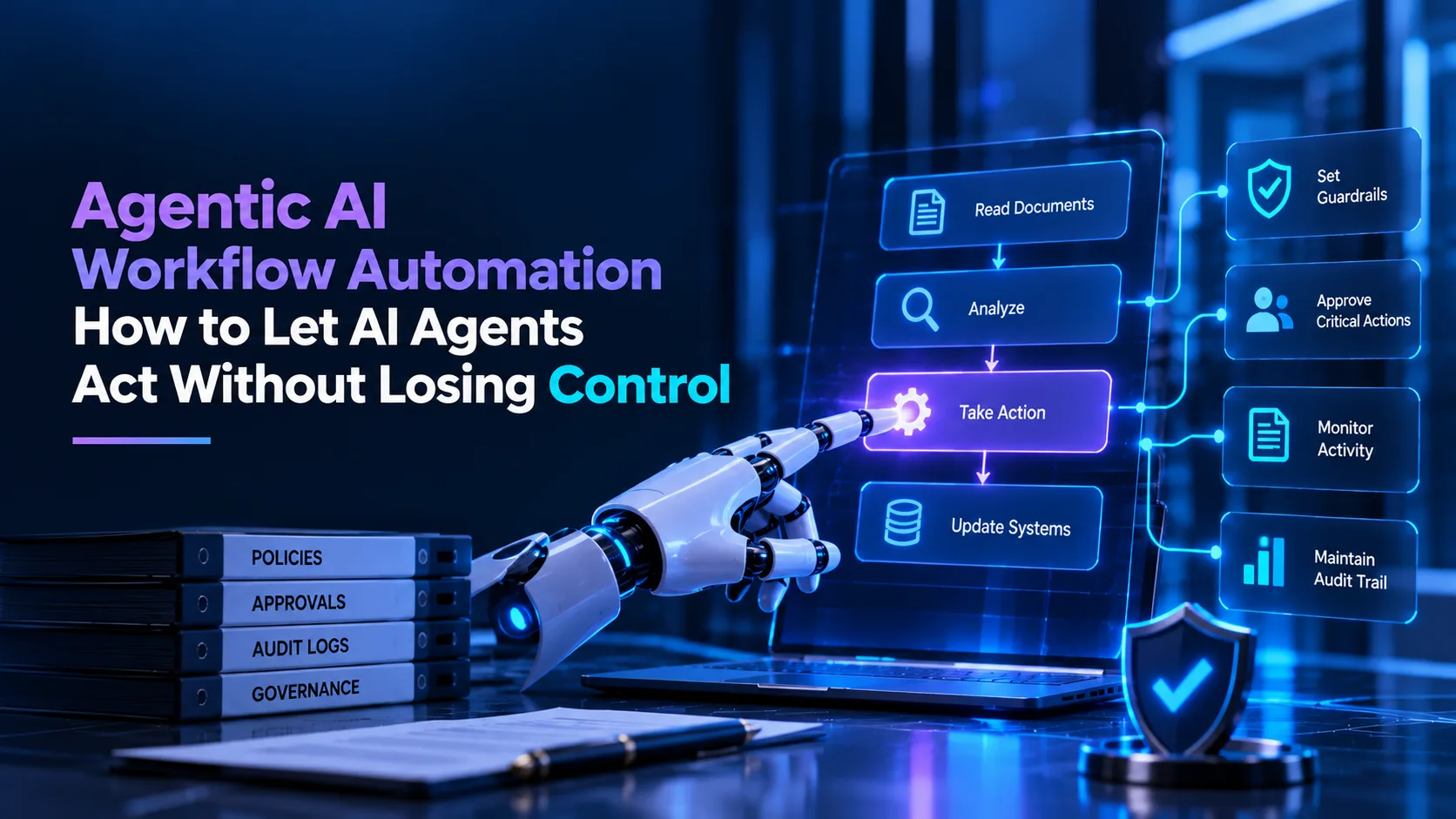
The fix is not less autonomy. It is autonomy with structural limits. TeamSync calls this bounded autonomy, and it rests on five controls.
1. Enforced tool surface
The actions an agent can take are declared in business rules and enforced at the platform layer. If an action isn't on the approved list, the agent simply can't reach it, no matter what the input says. When an auditor asks what the agent was allowed to do, you can show a configuration rather than a prompt.
2. Bounded retrieval
An agent should see only what the person it is working for is allowed to see. Role-based access control applies to agents exactly as it does to people, so a claims agent never pulls HR files "for context."
3. Human-in-the-loop checkpoints
You set the thresholds: claim value, contract risk score, confidence level or document type. Anything above them pauses for human approval. Routine work flows through, while high-impact decisions get a person.
4. Immutable audit trail
Every action and every refusal is recorded along with the input, the rule that applied and the outcome. This turns compliance documentation from a project into a query.
5. Versioning and rollback
Agents will occasionally get things wrong. Because agent actions are versioned like any other change, you can restore a document or workflow state to the point before the agent acted.
What this means for compliance
EU AI Act. Whether a deployment counts as high-risk depends on the use case. Where it does, anchored actions and human oversight evidence give you most of the documentation you need.
India's DPDP Act. Personal data must be processed for a specified purpose with reasonable security safeguards. Bounded retrieval and a full action log help show that agents touched only the data they were permitted to, for the purpose they were configured for.
HIPAA, SOC 2, ISO 27001. The same access controls and audit evidence carry across frameworks, so you don't need a separate story for each auditor.
How to Pick Your First Agentic Workflow
Don't start with your most complex process. Score candidate workflows against these five questions. The best first project answers yes to at least four.
Is it high-volume? Hundreds of items a week, not ten a month.
Is it document-heavy? The bottleneck is reading and sorting, not deciding.
Can you write down the escalation rules? You know which value, risk or document type needs a human.
Can you measure it today? You know the current cycle time or backlog, so you can prove improvement.
Is it reversible? A wrong routing can be corrected without real-world harm.
Claims intake, invoice exceptions, KYC completeness checks, contract first-pass review, and vendor onboarding usually score well. Final credit decisions and medical treatment choices do not, at least not as a first project.
How to Measure ROI from Agentic AI Workflow Automation
Measure the workflow, not the AI. Track these before and after go-live:
First-pass cycle time. How long from arrival to the first meaningful action.
Touches per item. How many times a person handles each case.
Escalation rate. The share of items going to humans. Too high means your thresholds are too tight, and too low means you should check quality.
Correction rate. How often humans override the agent's decision.
Backlog age. How long items wait in the queue.
Audit preparation time. The hours spent gathering evidence for reviews.
A strong pilot usually shows faster cycle times within weeks, then a falling correction rate as you tune the rules.
How TeamSync Approaches Agentic AI Workflow Automation
TeamSync is a regulated content and AI platform. Its agentic AI workflow sits on the same foundation as your documents, so agents don't need to copy data into another tool to act on it. In practice, that means:
Agents work directly with your intelligent repository, metadata extraction and OCR/ICR, and semantic search.
Workflows are configured in a visual designer from document types, metadata and rules you already have, with custom code optional.
Every agent action feeds the compliance audit trail, alongside eSignatures, contract lifecycle management and eDiscovery.
You can deploy in the cloud or on your own infrastructure, depending on your data residency requirements.
The result is AI that acts, inside limits you can prove.