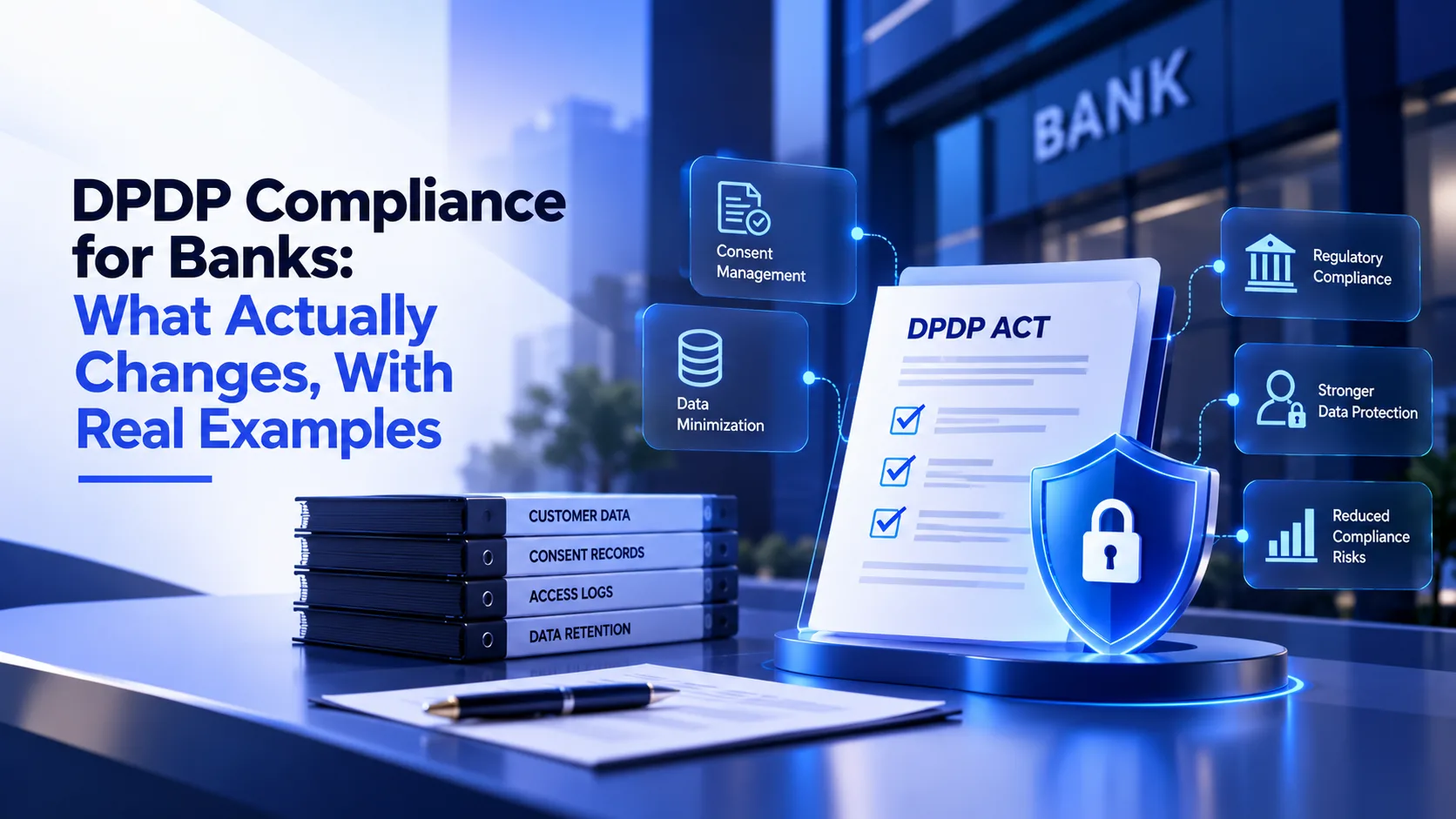
A customer applies for a home loan, gets rejected, and walks away. Three years later, her salary slips, PAN, Aadhaar copy and bank statements are still sitting in a shared drive at the branch, in the loan officer's email, and in a DSA's WhatsApp. Under India's DPDP Act, that forgotten file is a liability.
DPDP compliance for banks isn't just about writing a privacy policy. The real work is finding where customer data lives, proving why you hold it, and showing an auditor exactly who touched it. Here's what the law asks for, and how TeamSync helps banks get there.
The Deadline and the Stakes
The DPDP Rules, 2025 were notified on 14 November 2025 and set an 18-month phased timeline. Full compliance is due by 13 May 2027, with no grace period after that date.
The penalties are the steepest of any Indian privacy rule:
Up to ₹250 crore for failing to maintain reasonable security safeguards
Up to ₹200 crore for failing to report a breach or for violating children's data rules
Up to ₹150 crore for non-compliance by a Significant Data Fiduciary
Up to ₹50 crore for other violations
With crores of customer records, most large banks are likely to be designated Significant Data Fiduciaries. That brings extra duties: an independent data auditor, periodic audits and Data Protection Impact Assessments.
Five DPDP Obligations That Hit Banks Hardest
1. Consent that is specific, not bundled
Consent must be free, specific, informed and unambiguous, and withdrawing it must be as easy as giving it.
Example: a savings account opening form has one checkbox covering "account services, offers and partner products." Under DPDP, the bank can process data for the account itself, but using it to cross-sell insurance needs separate, specific consent. If the customer withdraws marketing consent in the app, the campaign team's next list must reflect it.
2. Purpose limitation and retention, which is the RBI conflict
DPDP says to erase personal data once its purpose is served, unless another law requires you to keep it. Banking law often does: PMLA and RBI KYC norms require records to be kept for five years after the relationship ends.
Example: the rejected home loan applicant above. The bank has no business reason to keep her file indefinitely. The fix is a retention schedule tied to document type. An active KYC record is retained per PMLA, while a rejected application's supporting documents are deleted after the defined period, and the deletion itself is logged.
3. Security safeguards across documents, not just core banking
Most banks have locked down the core banking system. The exposure sits elsewhere: scanned KYC copies, loan files, signed forms and email attachments. The DPDP Rules expect safeguards such as encryption, masking and access controls across all of it.
Example: a branch operations folder that every employee can open, holding 40,000 scanned Aadhaar copies, is exactly what a ₹250 crore safeguards penalty is designed for.
4. Breach reporting on two clocks
Banks already report cyber incidents to CERT-In and RBI within 6 hours. DPDP adds a separate duty: inform affected customers without delay, and send a detailed report to the Data Protection Board within 72 hours. You can't meet either deadline if it takes a week to work out which documents were exposed.
5. Customer rights requests
Customers can ask what data you hold about them, request corrections, raise grievances or nominate someone to act for them. When a customer asks what the bank has on file about them, the answer must cover the PDFs in the DMS, not just the CBS record.
Vendors Count Too
Collection agencies, DSAs, KYC verification partners and cloud providers are your Data Processors. The bank stays accountable for what they do with customer data. Contracts need DPDP clauses, and access should be limited to the specific records a vendor needs, for as long as it needs them.
RBI is moving in the same direction. On 15 July 2026, it released draft guidance on data governance expectations covering commercial banks, small finance banks, payment banks, cooperative banks, NBFCs and other regulated entities.
A Quick DPDP Readiness Checklist for Banks
Map where personal data lives, including scans, emails and branch folders.
Tag each document with its purpose and the law that governs its retention.
Separate consents by purpose and make withdrawal one click.
Apply role-based access so that staff and vendors see only what they need.
Automate deletion when retention periods end, and log every deletion.
Rehearse a breach: can you name the affected customers within hours?
Keep a tamper-evident audit trail ready for the Data Protection Board or your data auditor.
How TeamSync Helps Banks Become DPDP-Ready
TeamSync is a regulated content and AI platform built for the documents where most bank personal data actually sits.
Find personal data in unstructured files. Metadata extraction and OCR/ICR read scanned KYC copies and loan files, then tag PAN, Aadhaar and account details automatically.
Enforce access. Role-based access control limits who, including vendors, can open what.
Apply retention rules. Retention is set by document type, so PMLA records stay while expired applications are deleted, with proof.
Answer the Board quickly. A tamper-evident audit trail records every view, share, change and deletion, which turns an inquiry into a report rather than a scramble.
Deploy your way. Banks can run TeamSync on-premises or in the cloud to meet data residency requirements.
Frequently Asked Questions
Does DPDP apply to cooperative banks and NBFCs?
Yes. The Act applies to any entity processing digital personal data of individuals in India, including scheduled commercial banks, small finance banks, cooperative banks, payment banks and NBFCs.
Does DPDP override RBI's KYC retention rules?
No. Where another law requires you to retain data, you can keep it for that purpose. You must still secure it, limit access to it and delete it once the legal period ends.
Does DPDP apply to existing customer data?
Yes. Data collected before the Act still falls under DPDP once its obligations apply, so legacy files and archives need the same controls.
Start Before the Deadline Starts Counting Against You
May 2027 is closer than it looks for a bank with decades of records. Start by finding your unstructured personal data, because that is where most banks are exposed. Book a demo to see how TeamSync makes DPDP compliance for banks provable, not just documented.