On this page
- Level 1: Ad Hoc; AI Without Direction
- Level 2: Reactive; Solving Problems After They Happen
- Level 3: Defined; Building a Consistent Governance Framework
- Level 4: Managed; Turning Governance Into Strategic Intelligence
- Level 5: Optimized; Creating a Culture of Continuous AI Governance
- Assess Your AI Governance Maturity
- Governance Foundation
- Risk and Compliance
- Visibility and Reporting
- Continuous Improvement
- Interpreting Your Score
- Why Maturity Matters
- Ready to Strengthen Your AI Governance?
As organizations accelerate AI adoption, a new benchmark survey from the American Arbitration Association (AAA) reveals that governance maturity remains closely tied to AI experience. The findings show that organizations with more advanced AI implementations are significantly more likely to have structured, enforceable governance practices in place.
The report reinforces a critical message: effective AI governance should be built alongside AI adoption, not after AI has become deeply embedded across the business.
Artificial intelligence is moving from experimentation to enterprise-wide adoption at an unprecedented pace. Organizations across industries are integrating AI into customer service, operations, analytics, and decision-making workflows. Yet, while AI deployment is accelerating, governance frameworks often struggle to keep up.
AI adoption is accelerating, but governance is struggling to keep pace. Deloitte's 2026 State of AI in the Enterprise report found that while organizations are becoming more confident in their AI strategies, many still feel unprepared when it comes to the operational foundations needed to scale AI, including risk management, governance, data, and infrastructure.
This finding highlights a growing reality: organizations are investing in AI faster than they are building the governance structures required to manage it responsibly, securely, and at scale.
Without clear governance, organizations face risks ranging from compliance failures and data misuse to model bias, security vulnerabilities, and a lack of accountability. More importantly, poor governance limits innovation because teams lack the confidence and visibility needed to scale AI responsibly.
The good news is that AI governance maturity is not an all-or-nothing proposition. Organizations evolve through distinct stages, gradually building the policies, processes, oversight, and automation required to govern AI effectively.
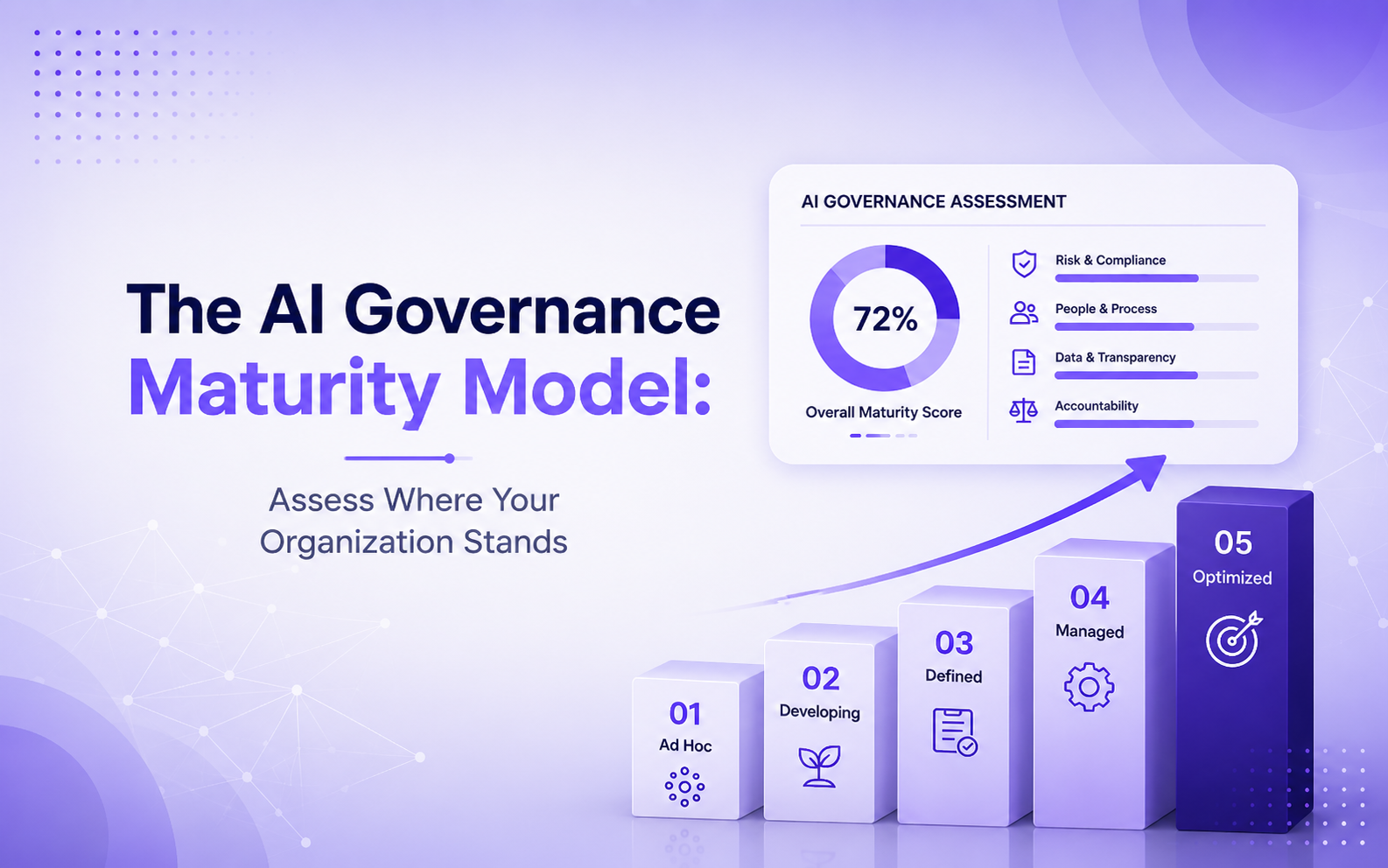
This AI governance maturity model helps organizations assess their current state, identify gaps, and define the next steps toward responsible and scalable AI adoption.
Level 1: Ad Hoc; AI Without Direction
At the Ad Hoc stage, AI adoption happens organically across the organization, with individual teams experimenting with different tools independently. There are no formal governance policies, little documentation, and limited executive visibility into how AI is being used. While this encourages innovation, it also creates significant risks such as shadow AI, data privacy issues, regulatory exposure, and inconsistent outcomes. TeamSync helps organizations establish a foundation by centralizing AI initiatives, improving visibility, standardizing workflows, and creating a shared repository for governance documentation. The objective at this stage is to move from isolated experimentation toward coordinated oversight.
Level 2: Reactive; Solving Problems After They Happen
As AI adoption grows, organizations begin recognizing the need for governance, but their approach remains largely reactive. Governance activities are triggered by incidents or compliance concerns rather than being built into everyday operations. Approval processes are often manual, policy enforcement varies between departments, and operational inefficiencies become more apparent. TeamSync supports this transition by introducing structured approval workflows, cross-functional review processes, incident tracking, and centralized audit records. The goal is to replace ad hoc responses with repeatable governance practices that reduce risk before issues escalate.
Level 3: Defined; Building a Consistent Governance Framework
At the Defined stage, AI governance becomes a formal organizational capability. Policies are documented, ownership is clearly assigned, and standardized risk assessment and review processes are established across departments. This creates greater consistency, strengthens accountability, and reduces compliance risks as AI initiatives continue to expand. TeamSync enables organizations to operationalize these governance processes through policy management workflows, governance templates, role-based permissions, automated notifications, and standardized review cycles. The focus is on creating transparency and consistency across the enterprise.
Level 4: Managed; Turning Governance Into Strategic Intelligence
Organizations at the Managed level move beyond simply following governance processes and begin measuring their effectiveness. Governance decisions become data-driven through KPIs, centralized dashboards, formal risk scoring, regular audits, and executive oversight. At this stage, AI governance strategic visibility becomes a competitive advantage, allowing leaders to understand AI performance, compliance status, business impact, and emerging risks in real time. TeamSync supports this maturity by providing governance dashboards, executive reporting, automated compliance tracking, portfolio-wide oversight, and continuous risk monitoring. The goal is to transform governance from an administrative function into a strategic business capability.
Level 5: Optimized; Creating a Culture of Continuous AI Governance
At the highest maturity level, AI governance becomes deeply integrated into the organization's culture and evolves alongside business needs. Governance is embedded throughout the AI lifecycle, supported by automated controls, real-time compliance monitoring, and strong collaboration between business, legal, IT, and leadership teams. Organizations at this stage embrace AI governance continuous improvement, continuously refining policies, controls, and governance processes as regulations, technologies, and risks evolve. TeamSync enables this through automated governance workflows, lifecycle management, advanced analytics, continuous monitoring, and enterprise-wide collaboration. The objective is to create a self-improving governance ecosystem that enables responsible AI innovation at scale.
Assess Your AI Governance Maturity
Knowing where your organization stands is the first step toward improving AI governance. Many businesses believe they have governance in place, but when they assess their processes, they often discover gaps in visibility, accountability, risk management, or policy enforcement. This simple self-assessment helps you evaluate your current maturity level and identify areas that need attention.
For each statement below, assign yourself a score:
0 points: Not in place
1 point: Partially implemented
2 points: Fully implemented
Governance Foundation
Start by evaluating the foundations of your AI governance program. Does your organization have documented AI governance policies? Are roles and responsibilities clearly defined so employees understand who is accountable for AI decisions? Finally, are AI initiatives formally reviewed before deployment, or can teams adopt AI tools without oversight?
Risk and Compliance
Next, assess how well your organization manages AI-related risks. Do you conduct formal AI risk assessments before implementing new AI systems? Are compliance requirements reviewed regularly to keep pace with changing regulations? If an AI-related incident occurs, is there a structured process to document, investigate, and resolve it?
Visibility and Reporting
Strong governance requires leaders to understand how AI is being used across the organization. Consider whether executives have visibility into all AI initiatives, whether governance metrics are reported consistently, and whether AI policies, decisions, and documentation are maintained in a centralized location.
Continuous Improvement
AI governance should never remain static. Organizations with mature governance programs regularly review their processes, update policies to reflect new regulations and emerging risks, and continuously optimize governance workflows to improve efficiency and oversight. Consider how well your organization performs in these areas.
Interpreting Your Score
Once you've scored each statement, add up your total and compare it against the maturity scale below.
0–5 points
Level 1: Ad Hoc: AI initiatives are largely unmanaged, with little formal governance or executive oversight.
6–10 points
Level 2: Reactive: Governance exists but is primarily driven by problems, incidents, or compliance requirements after they occur.
11–15 points
Level 3: Defined: Governance policies, ownership, and review processes are documented and consistently followed across the organization.
16–20 points
Level 4: Managed: Governance is actively monitored using metrics, executive reporting, and structured risk management practices, providing strong AI governance strategic visibility.
21–24 points
Level 5: Optimized: Governance is embedded throughout the AI lifecycle, supported by automation, continuous monitoring, and a culture of AI governance continuous improvement.
No matter where your organization scores today, AI governance is a journey rather than a destination. Each stage represents an opportunity to strengthen oversight, reduce risk, and build greater confidence in enterprise AI adoption. With TeamSync, organizations can systematically progress through each maturity level, transforming governance from a compliance requirement into a strategic advantage.
Why Maturity Matters
AI governance is not simply a compliance exercise. Mature governance programs accelerate innovation by establishing trust, improving visibility, reducing risk, and enabling organizations to scale AI with confidence.
Organizations that intentionally invest in governance maturity position themselves to unlock greater business value while staying ahead of evolving regulatory expectations.
The journey toward mature governance does not happen overnight. It requires steady progress, executive sponsorship, and the right operational tools.
Ready to Strengthen Your AI Governance?
Understanding your AI governance maturity is only the first step. The real value comes from putting the right processes, visibility, and controls in place to scale AI with confidence. Book a demo with TeamSync to see how you can simplify governance, reduce risk, and build a framework that grows with your organization.