On this page
- Why AI Governance Matters More Than AI Itself
- Failure #1: Apple Card and the Fair Lending Controversy
- Failure #2: Black-Box Credit Models Cannot Hide Behind Complexity
- Failure #3: AI-Assisted Healthcare Decisions Under Legal Scrutiny
- Failure #4: FDA's AI Warning for Pharmaceutical Manufacturing
- The Common Pattern Behind Every AI Governance Failure
- Conclusion: The Next Step Is Stronger AI Governance
A recent $409 million fine imposed on South Korean e-commerce giant Coupang has once again highlighted the cost of weak AI and data governance. Regulators found inadequate access controls that exposed the personal information of around 33 million customers, reinforcing that governance failures, not just AI failures, can lead to severe financial, regulatory, and reputational consequences. For enterprises, it's a clear AI governance wake-up call that strong governance is essential for responsible AI adoption.
Artificial intelligence is transforming regulated industries faster than governance programs can keep up. Banks are using AI to accelerate credit decisions, healthcare organizations are deploying AI to support clinical workflows, and pharmaceutical companies are streamlining research, manufacturing, and quality processes with generative AI. As AI becomes deeply embedded in critical business operations, the challenge is no longer adoption; it's governance.
While organizations race to deploy AI, governance continues to lag behind. A Trustmarque study found that 93% of organizations already use AI, but only 7% have fully embedded AI governance frameworks, and just 8% have integrated AI governance into their software development lifecycle. The report warns that fragmented oversight leaves organizations vulnerable to bias, privacy breaches, regulatory scrutiny, and costly operational failures.
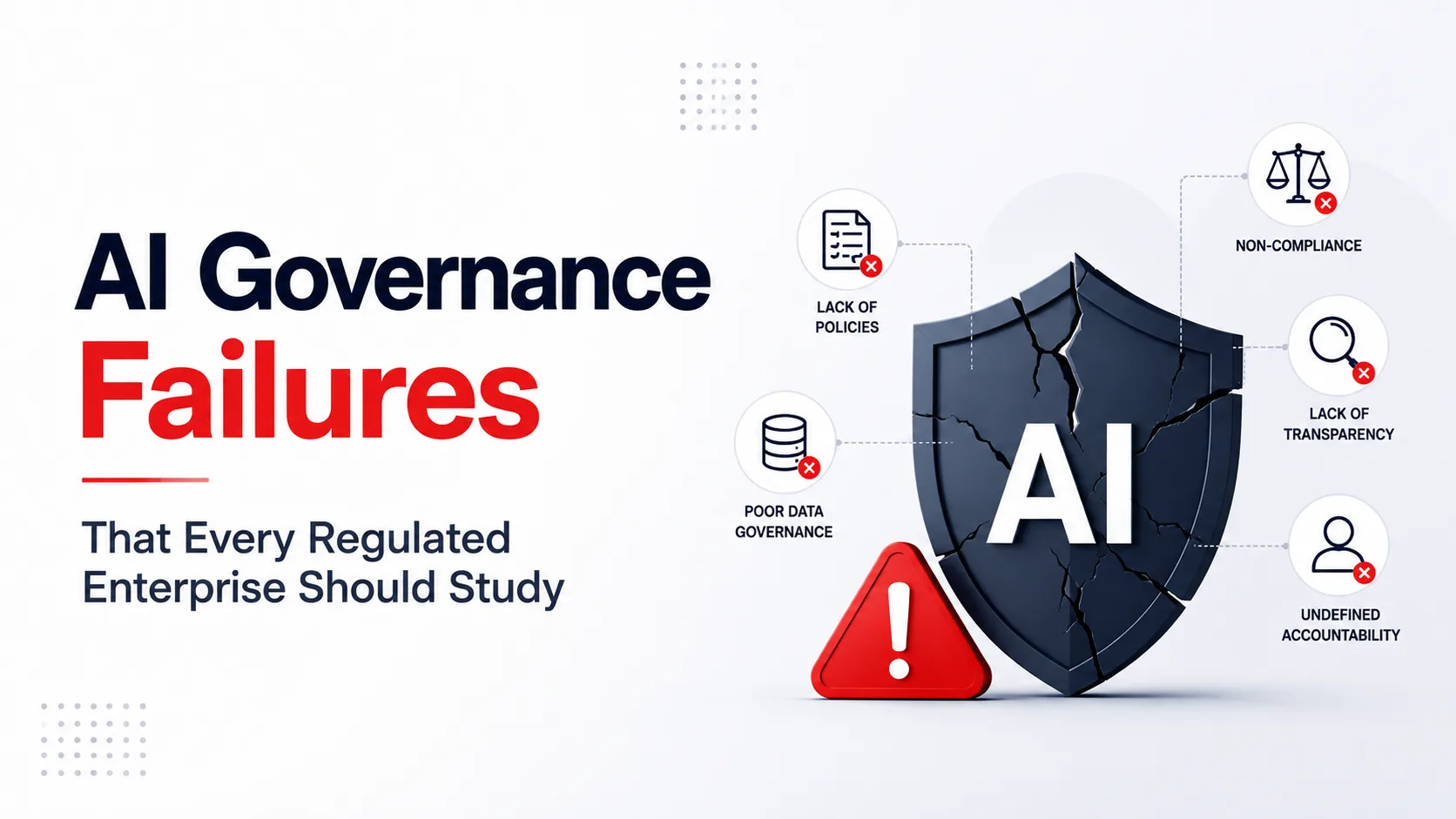
This is why the growing number of AI governance failures should concern every regulated enterprise. In many cases, the AI models weren't fundamentally flawed; the governance around them was. Poor oversight, inadequate validation, lack of explainability, and weak documentation turned promising AI initiatives into compliance and reputational risks, making this an undeniable AI governance wake-up call. Addressing these AI governance challenges requires a structured approach to AI governance risk and compliance.
Platforms like TeamSync help organizations centralize AI inventories, automate risk assessments, map controls to regulatory frameworks, and maintain audit-ready evidence, enabling responsible AI adoption at scale.
In this article, we'll examine four real-world AI governance failures, the governance gaps behind them, and the lessons every regulated enterprise should learn.
Why AI Governance Matters More Than AI Itself
Many organizations focus on selecting the "best" AI model. Regulators, however, care about something far more important: whether the AI is governed responsibly throughout its lifecycle. Questions around ownership, transparency, monitoring, and compliance determine whether an AI initiative succeeds or becomes an AI governance failure. As recent incidents have shown, they also serve as an AI governance wake-up call for organizations operating in regulated industries. Addressing these AI governance challenges requires a strong foundation in AI governance risk and compliance, not just better algorithms.
1. Clear Ownership and Accountability
Every AI system should have a designated owner responsible for its development, deployment, and ongoing oversight. Without clear accountability, governance gaps emerge, making it difficult to investigate incidents, assign responsibility, or demonstrate compliance during audits.
2. Data Quality and Integrity
AI models are only as reliable as the data they are trained on. Organizations must ensure that training data is accurate, representative, unbiased, and compliant with privacy regulations. Poor data governance is one of the leading causes of AI governance failures, often resulting in biased outcomes and regulatory scrutiny.
3. Transparency and Explainability
In regulated industries, organizations must be able to explain how AI systems arrive at critical decisions. Whether it's approving a loan or supporting a clinical diagnosis, explainability builds trust, supports compliance, and helps prevent an AI governance failure caused by opaque or "black-box" models.
4. Continuous Monitoring and Risk Management
AI governance doesn't end after deployment. Models should be continuously monitored for bias, data drift, security risks, and performance degradation. Proactive monitoring helps organizations address AI governance challenges before they escalate into compliance violations or operational failures.
5. Compliance Documentation and Audit Readiness
Every stage of the AI lifecycle, from approvals and risk assessments to model updates and incident responses, should be documented. Maintaining audit-ready evidence strengthens AI governance risk and compliance, enabling organizations to meet regulatory expectations under frameworks like the EU AI Act, NIST AI RMF, HIPAA, FDA regulations, and financial services requirements.
Failure #1: Apple Card and the Fair Lending Controversy
Industry: Financial Services
In 2019, Apple Card faced widespread criticism after customers claimed women received lower credit limits than men with similar financial profiles. While the New York Department of Financial Services found no evidence of unlawful discrimination, the incident exposed a major governance gap: AI-driven decisions must be transparent and explainable. Even when models are legally compliant, poor explainability can erode trust and attract regulatory scrutiny. The controversy remains a notable AI governance failure and an important AI governance wake-up call for financial institutions.
What went wrong?
Lack of Explainability: Customers couldn't understand how credit decisions were made.
Weak Governance: The focus was on model performance rather than accountability, documentation, and oversight.
Trust and Reputation Risks: Limited transparency damaged public confidence and increased regulatory attention.
Governance lesson
Organizations should ensure AI decisions are explainable, auditable, and well documented. Strong AI governance risk and compliance practices help reduce risk while building customer trust.
Failure #2: Black-Box Credit Models Cannot Hide Behind Complexity
Industry: Banking
As banks increasingly adopted AI for credit decisions, many argued that complex machine learning models made it impossible to explain why certain applicants were denied credit. However, the Consumer Financial Protection Bureau (CFPB) clarified that AI complexity is not an excuse for non-compliance. Lenders are still required to provide clear reasons for adverse decisions. This AI governance failure demonstrated that explainability isn't just a technical requirement; it's a regulatory one and an AI governance wake-up call for financial institutions.
What went wrong?
Poor Explainability: AI decisions couldn't be clearly justified to customers or regulators.
Governance Gap: Organizations prioritized model accuracy over documentation and transparency.
Regulatory Risk: Lack of decision traceability increased compliance exposure.
Governance lesson
Every production AI model should include documented reasoning, decision traceability, and ongoing oversight. Strong AI governance risk and compliance practices help organizations overcome these AI governance challenges while maintaining customer trust.
Failure #3: AI-Assisted Healthcare Decisions Under Legal Scrutiny
Industry: Healthcare
UnitedHealth's subsidiary, naviHealth, has faced lawsuits alleging that AI-supported tools influenced premature denials of Medicare Advantage coverage for post-acute care. While legal proceedings are ongoing, the case highlights how AI used in patient care can quickly become a governance issue when human oversight is inadequate. It serves as another AI governance wake-up call for healthcare organizations relying on AI in high-impact decisions.
What went wrong?
Limited Human Oversight: AI recommendations allegedly influenced care decisions without sufficient clinical review.
Accountability Issues: Organizations struggled to demonstrate meaningful governance over AI-assisted decisions.
Patient Trust Risks: AI-driven decisions affecting healthcare received significant public and regulatory attention.
Governance lesson
High-risk healthcare AI should always include clinician oversight, validation, and continuous monitoring. These controls strengthen AI governance risk and compliance while helping organizations address evolving AI governance challenges.
Failure #4: FDA's AI Warning for Pharmaceutical Manufacturing
Industry: Pharmaceutical Manufacturing
In 2026, the FDA issued a warning letter after a pharmaceutical manufacturer used AI to generate regulated manufacturing documents without adequate Quality Unit review. The incident reinforced that AI can support regulated workflows, but it cannot replace human accountability. It became an AI governance wake-up call for pharmaceutical organizations adopting generative AI in quality and compliance processes.
What went wrong?
Overreliance on AI: AI-generated documents were used without sufficient human review.
Weak Governance Controls: Documentation lacked proper oversight and approval workflows.
Compliance Risks: Critical quality records failed to meet regulatory expectations.
Governance lesson
Generative AI should strengthen, not replace, quality management systems. Building robust AI governance risk and compliance processes ensures AI-generated content remains accurate, compliant, and audit-ready while reducing future AI governance failures.
The Common Pattern Behind Every AI Governance Failure
While these incidents occurred across different industries, from banking and healthcare to pharmaceutical manufacturing, they all point to the same underlying issue: poor governance. In most cases, the AI technology itself wasn't fundamentally flawed. Instead, organizations failed to establish the controls needed to govern AI responsibly, including clear ownership, model validation, explainability, human oversight, continuous monitoring, and proper documentation. These recurring AI governance challenges have transformed isolated incidents into industry-wide lessons.
The biggest takeaway is that regulators don't just evaluate what an AI model does; they evaluate how it is governed. Organizations that cannot demonstrate accountability, transparency, and audit-ready evidence face increased regulatory scrutiny, reputational damage, and operational risk. Every high-profile AI governance failure reinforces the need for governance to be embedded throughout the AI lifecycle, not treated as an afterthought.
Ultimately, these incidents serve as an AI governance wake-up call for every regulated enterprise. Building strong AI governance risk and compliance processes isn't just about meeting regulatory expectations; it's about creating trustworthy AI systems that can scale safely, responsibly, and with confidence.
Conclusion: The Next Step Is Stronger AI Governance
The organizations that avoid tomorrow's headlines aren't necessarily the ones using less AI; they're the ones governing it better. As these real-world examples demonstrate, most AI governance failures don't happen because AI is inherently flawed. They happen because organizations lack the processes, accountability, and oversight needed to manage AI responsibly. For regulated enterprises, this should be an AI governance wake-up call to strengthen AI governance risk and compliance before small governance gaps become costly business risks.
Building a mature AI governance program requires more than policies and periodic audits. It requires continuous visibility into AI systems, structured risk assessments, compliance mapping, clear ownership, and audit-ready documentation. TeamSync helps organizations bring all these capabilities together in a centralized platform, enabling them to manage AI governance proactively while staying aligned with evolving regulatory requirements.
If you're wondering how prepared your organization really is, the next step isn't another AI tool; it's understanding your governance maturity. In our next guide, we'll explore the AI Governance Maturity Model, helping you benchmark your current capabilities, identify governance gaps, and build a roadmap for responsible, compliant, and scalable AI adoption.