On this page
- Why Organizations Experience AI Governance Paralysis
- Unclear Ownership Creates Decision Bottlenecks
- Too Many Stakeholders, Too Few Decisions
- Fear of Regulatory and Compliance Risks
- No Structured Way to Prioritize AI Initiatives
- Governance Without Action Slows Innovation
- Why Top-Down AI Governance Works
- Leadership Defines Governance Principles
- Risk Tolerance Is Clearly Established
- Standardized Approval Processes Reduce Delays
- Accountability Becomes Clear
- Escalation Pathways Enable Faster Decisions
- It Creates Enterprise-Wide Consistency
- Executive Actions to Break the Deadlock
- 1. Assign Executive Ownership
- 2. Establish Governance Principles Early
- 3. Create an AI Governance Committee
- 4. Standardize Intake and Prioritization
- 5. Focus on Enablement, Not Restriction
- The Future of AI Governance Belongs to Decisive Leaders
- How TeamSync Helps Organizations Move Beyond AI Governance Paralysis
Federal AI policy is shifting from broad governance discussions to practical execution. As AI spending across U.S. agencies rises sharply, the focus is moving toward how governments can coordinate adoption, manage risks, and deliver measurable outcomes. The creation of the Chief AI Officers Council reflects this transition, showing that AI governance now requires both strategic oversight and operational accountability.
Enterprise AI adoption is accelerating faster than governance. According to recent research, 88% of organizations now use AI in at least one business function, but only 8% have a comprehensive AI governance framework. This gap explains why many organizations struggle to move AI from experimentation to enterprise-wide deployment. While teams are eager to adopt AI, many businesses still lack the structures needed to manage it consistently, securely, and at scale.
As AI initiatives spread across departments, organizations often become trapped in AI governance paralysis. Executives struggle to agree on ownership, governance committees, approval processes, and risk priorities. At the same time, individual business units continue adopting AI independently, leading to shadow AI, duplicated investments, inconsistent governance practices, and growing compliance risks. Without clear leadership, AI adoption becomes fragmented rather than strategic.
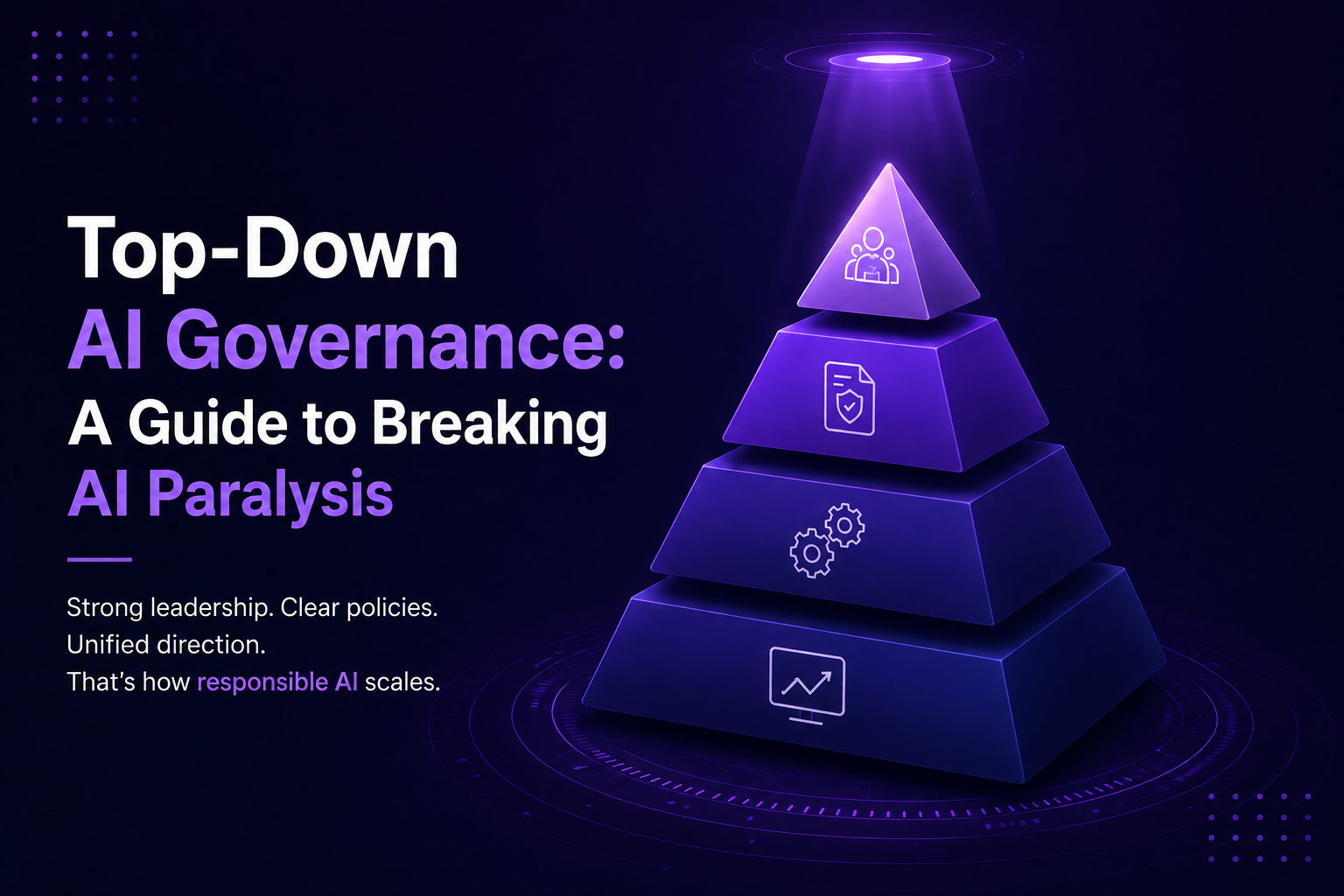
Breaking this deadlock requires top-down AI governance, where executive leadership establishes clear accountability, standardized decision-making, and enterprise-wide governance from the outset. Instead of slowing innovation, this approach provides teams with the structure and confidence needed to adopt AI responsibly while aligning every initiative with business goals.
Why Organizations Experience AI Governance Paralysis
Despite recognizing AI's potential, many organizations struggle to move beyond discussions and pilot projects. They invest time in developing policies, evaluating risks, and forming governance strategies, but implementation often stalls. This is what AI governance paralysis looks like. The problem is rarely a lack of interest in AI. Instead, it stems from organizational challenges that make decision-making slow and complex.
Unclear Ownership Creates Decision Bottlenecks
One of the biggest causes of AI governance paralysis is the absence of clear ownership. AI touches multiple functions across the organization, including IT, legal, compliance, risk management, security, and business operations. While each team plays an important role, uncertainty about who has the final authority often delays decisions.
Without executive sponsorship or a clearly designated owner, governance responsibilities become fragmented. Teams wait for approvals, responsibilities overlap, and important initiatives remain stuck in planning instead of moving into execution.
Too Many Stakeholders, Too Few Decisions
AI is no longer confined to a single department. Marketing uses generative AI for content creation, HR experiments with AI-assisted recruitment, finance explores forecasting models, and legal teams automate contract management. Because AI impacts so many business functions, every department wants to participate in governance discussions.
While collaboration is essential, involving too many stakeholders without a defined decision-making process often results in lengthy meetings, conflicting priorities, and slow approvals. Instead of enabling innovation, governance becomes an administrative bottleneck.
Fear of Regulatory and Compliance Risks
The rapid evolution of AI regulations has made many organizations cautious about expanding AI initiatives. Frameworks such as the EU AI Act, along with growing expectations around privacy, transparency, and accountability, have increased executive concerns about compliance.
As a result, many organizations delay AI projects until every possible risk has been addressed. Although managing risk is important, excessive caution can prevent businesses from capturing the value AI offers. Effective governance should reduce uncertainty, not create more of it.
No Structured Way to Prioritize AI Initiatives
As AI adoption grows, organizations receive an increasing number of requests from different departments. Every team believes its project is a priority, whether it involves customer service automation, predictive analytics, content generation, or workflow optimization.
Without a standardized process for evaluating these requests, leadership struggles to determine which initiatives align with business objectives and which require immediate governance review. Projects accumulate, approvals slow down, and valuable opportunities remain on hold. Implementing an AI governance intake prioritization workflow helps organizations evaluate requests consistently, prioritize high-value initiatives, and move projects forward with greater confidence.
Governance Without Action Slows Innovation
The greatest irony of AI governance paralysis is that organizations are trying to reduce risk but often create a different kind of risk by delaying decisions. While governance discussions continue, business units may adopt AI tools independently, creating shadow AI, inconsistent practices, and limited executive visibility.
Successful organizations recognize that governance should not delay innovation. With clear leadership, defined ownership, and structured workflows, governance becomes an enabler that helps businesses scale AI responsibly rather than a barrier that slows progress.
Why Top-Down AI Governance Works
As organizations expand their use of AI, governance cannot be left to individual departments to figure out on their own. Different teams have different priorities, risk tolerances, and ways of working. Without clear direction from leadership, governance quickly becomes inconsistent, making it difficult to scale AI across the enterprise. This is where top-down AI governance becomes essential.
A top-down approach ensures that executive leadership sets the strategic direction for AI while giving business units the flexibility to innovate within clearly defined boundaries. Instead of creating barriers to innovation, it provides a common framework that helps every team make faster and more consistent decisions.
Leadership Defines Governance Principles
Every organization needs a shared set of governance principles that guide how AI should be developed, deployed, and monitored. Executive leadership establishes these principles based on the organization's business objectives, ethical standards, and regulatory obligations. This creates a consistent foundation that every department can follow, regardless of the AI tools or use cases they adopt.
Risk Tolerance Is Clearly Established
Not every AI application carries the same level of risk. An internal AI assistant used for drafting emails requires different oversight than an AI system used for loan approvals or medical decision-making. Through top-down AI governance, leadership defines acceptable risk levels and determines which projects require additional reviews, helping organizations balance innovation with responsible governance.
Standardized Approval Processes Reduce Delays
One of the biggest causes of AI governance paralysis is inconsistent approval procedures. Different departments often follow different review processes, leading to confusion and unnecessary delays. A centralized governance model introduces standardized approval workflows so every AI initiative follows a clear, predictable path from proposal to deployment.
Accountability Becomes Clear
AI projects often involve multiple stakeholders, including IT, legal, compliance, security, and business leaders. Without clearly assigned responsibilities, important decisions can become delayed or overlooked. A top-down governance model defines who owns each stage of the AI lifecycle, making accountability transparent and improving collaboration across teams.
Escalation Pathways Enable Faster Decisions
Not every AI project requires executive involvement. Top-down governance establishes clear escalation pathways so routine, low-risk initiatives can move forward quickly, while high-risk or business-critical projects are escalated to the appropriate decision-makers. This prevents leadership from becoming overwhelmed while ensuring that the most important AI initiatives receive the oversight they need.
It Creates Enterprise-Wide Consistency
Perhaps the greatest advantage of top-down AI governance is consistency. Every department operates under the same governance framework, follows the same standards, and works toward the same organizational objectives. This reduces uncertainty, strengthens compliance, and gives executives complete visibility into AI initiatives across the enterprise.
Most importantly, top-down AI governance enables organizations to make decisions faster. Instead of debating governance for every new AI initiative, leadership establishes the framework once, allowing teams to innovate confidently while staying aligned with business strategy, regulatory requirements, and organizational policies.
Executive Actions to Break the Deadlock
Breaking AI governance paralysis requires decisive leadership rather than more discussions. By taking a few strategic actions, executive teams can create a governance model that enables innovation while maintaining accountability and compliance.
1. Assign Executive Ownership
Every successful governance initiative starts with clear ownership. Designate a senior executive or leadership team responsible for enterprise AI governance. This person should have the authority to align business units, make governance decisions, and ensure AI initiatives support the organization's strategic objectives.
2. Establish Governance Principles Early
Many organizations delay implementation while trying to create the perfect governance framework. Instead, start with a set of foundational principles around responsible AI use, risk management, transparency, and accountability. These principles can evolve as regulations and business needs change, allowing governance to mature without slowing innovation.
3. Create an AI Governance Committee
An effective AI governance committee brings together representatives from IT, legal, compliance, risk, security, and business leadership. More importantly, the committee should have clearly defined decision-making authority so that governance discussions lead to timely approvals instead of prolonged debates.
4. Standardize Intake and Prioritization
As AI requests increase across the organization, every project cannot receive the same level of review. Implementing an AI governance intake prioritization workflow ensures each AI initiative is evaluated consistently based on business value, risk, compliance requirements, and strategic priorities. This helps leadership focus resources on the projects that deliver the greatest impact.
5. Focus on Enablement, Not Restriction
Governance should help teams adopt AI safely, not discourage them from innovating. The goal is to provide clear guidance, standardized processes, and appropriate oversight so employees can experiment confidently while remaining compliant with organizational policies and regulatory requirements.
The Future of AI Governance Belongs to Decisive Leaders
Organizations that continue debating governance frameworks without taking action risk falling behind competitors that are already operationalizing AI responsibly. As AI adoption accelerates, the competitive advantage will belong to businesses that can make informed decisions quickly while maintaining effective oversight.
The organizations leading the AI transformation are not necessarily those with the most detailed governance documents. They are the ones with strong executive leadership, clear accountability, standardized workflows, and efficient decision-making processes. Top-down AI governance transforms governance from a compliance exercise into a strategic business capability, enabling organizations to scale AI responsibly, innovate faster, and create long-term competitive advantage.
How TeamSync Helps Organizations Move Beyond AI Governance Paralysis
Many organizations already understand what effective AI governance should look like. The challenge lies in operationalizing it consistently across teams.
TeamSync helps enterprises break through AI governance paralysis by transforming governance processes into structured, automated workflows.
With TeamSync, organizations can:
Centralize AI use case submissions through a unified intake process.
Automate the AI governance intake prioritization workflow.
Route requests to the appropriate stakeholders automatically.
Enable AI governance committee reviews with complete visibility and audit trails.
Prioritize initiatives based on business impact and risk profiles.
Track approvals, escalations, and compliance activities in one place.
Rather than relying on spreadsheets, email chains, and manual coordination, TeamSync enables leaders to govern AI at scale while keeping innovation moving.
The result is faster decision-making, stronger accountability, and a governance framework that empowers the business instead of slowing it down.