On this page
- What AI governance tools actually do
- Why Generic Compliance Software Is Not Enough for AI Workflows
- Centralized AI Inventory
- Connected Policy Management
- Vendor Risk Management
- Data Lineage and System Visibility
- Human Review Checkpoints
- Incident Management and Reporting
- Cross-Functional Collaboration
- How to Compare AI Governance Platforms Based on Enterprise Needs
- What Large Enterprises Should Prioritize
- What Mid-Market Organizations Should Prioritize
- Red Flags to Watch for When Evaluating AI Governance Tools
- Policy Management Without Workflow Execution
- Poor Integration Capabilities
- Inadequate Audit Trails
- Unclear Risk Scoring
- Limited Support for Third-Party AI
- Weak Collaboration Features
- Dashboards Without Actionable Workflows
- Practical buying checklist for choosing the best tools for managing AI governance in workflows
- Conclusion: Enterprises need AI governance that is operational, not just theoretical
- See how to operationalize AI governance across team workflows
Enterprise interest in AI governance has moved far beyond theory. As organizations accelerate AI adoption across departments, governance is rapidly becoming a business necessity rather than a compliance exercise. The Stanford AI Index Report 2025 found that both enterprise AI adoption and responsible AI initiatives continued to increase, signaling a clear shift from experimentation to large-scale operational deployment. At the same time, the IBM Cost of a Data Breach Report 2025 highlighted a growing governance gap: AI adoption is outpacing AI security and oversight. IBM also reported that 13% of surveyed organizations had already experienced breaches involving AI models or applications, and 97% of those organizations lacked adequate AI access controls.
These findings reinforce a growing reality. As AI becomes embedded in business operations, organizations need clear visibility, accountability, and governance across every stage of the AI lifecycle. Even companies operating outside Europe are strengthening their governance capabilities because AI procurement, third-party vendors, regulatory expectations, and cross-border business increasingly demand documented governance practices.
The conversation has therefore shifted from whether organizations need AI governance to how they can implement it effectively. Enterprises are looking for AI governance platforms that do more than satisfy compliance requirements. They need solutions that streamline governance across legal, IT, security, procurement, operations, and business teams, enabling responsible AI adoption without creating unnecessary bottlenecks or slowing innovation.
This is where TeamSync comes in. TeamSync helps organizations operationalize AI governance by bringing AI requests, policy reviews, risk assessments, approvals, vendor evaluations, and compliance evidence into a single collaborative workflow. Instead of relying on spreadsheets, emails, and disconnected systems, enterprises gain a centralized platform that improves visibility, strengthens accountability, and creates audit-ready governance processes. The result is faster decision-making, stronger cross-functional collaboration, and AI governance that scales alongside the business.
What AI governance tools actually do
At a practical level, AI governance tools help organizations control how AI is selected, used, monitored, and reviewed. They turn governance from a static policy document into an operating system for decision-making. Instead of leaving AI use to scattered spreadsheets, email approvals, and disconnected risk memos, these tools create a structured way to document models, assign owners, track approvals, log evidence, manage contract management processes, and respond when something goes wrong.
In plain language, good AI governance tools help enterprises answer a few critical questions. What AI systems are being used across the business? Who approved them? What data do they touch? What rules apply to them? What risks were identified? What monitoring is in place? If an auditor or regulator asks for proof, where is the evidence?
This is where the difference between simple policy management and a real platform matters. A lightweight policy approach might store a responsible AI policy in a document repository and require employees to acknowledge it once a year. That is useful, but limited. A point compliance tool might add a questionnaire for high-risk use cases. A full enterprise platform goes further by maintaining a model inventory, applying access controls, routing approval requests, supporting contract management for AI vendors, logging prompts or outputs where appropriate, managing third-party vendor reviews, and creating incident response workflows when AI behavior triggers concern.
Consider a common example. A marketing team wants to use a third-party generative AI assistant to draft campaign copy. Governance is not just a yes or no decision. Someone may need to verify contract terms through contract management, review whether customer data can be entered into prompts, check brand or legal restrictions, decide whether outputs need human review, and define what records must be retained. Without tooling, those steps happen inconsistently. With the right platform, they become repeatable, visible, and fully documented.
Why Generic Compliance Software Is Not Enough for AI Workflows
Traditional GRC (Governance, Risk, and Compliance) platforms were built to manage policies, controls, audits, and periodic reviews. While these capabilities remain important, AI introduces a new level of complexity. Models evolve continuously, employees adopt new AI tools rapidly, and risks can emerge long after an initial approval. As a result, organizations need governance that is embedded into everyday workflows rather than limited to static policy documents. Modern AI governance platforms must connect policies with approvals, risk assessments, collaboration, monitoring, and ongoing oversight to ensure AI is used responsibly without slowing innovation.
Centralized AI Inventory
Organizations need a single source of truth for all AI models, copilots, and third-party AI tools. A centralized inventory improves visibility by assigning ownership, tracking business purpose, assessing risk, and monitoring review schedules.
Connected Policy Management
Policies should guide real-world decisions instead of sitting in documents. Effective platforms link governance policies to AI use cases, required controls, evidence, and regulatory obligations, ensuring the right level of oversight for every project.
Vendor Risk Management
Many enterprises rely on third-party AI solutions rather than building their own models. Governance platforms should support vendor assessments, contract reviews, security evaluations, and ongoing monitoring to reduce third-party risk.
Data Lineage and System Visibility
Organizations need to understand where AI systems obtain data and how outputs are used across business processes. Data lineage improves transparency, supports compliance, and helps teams identify downstream risks more quickly.
Human Review Checkpoints
AI should support, not replace, human judgment, especially in high-impact decisions. Built-in review stages ensure critical outputs are validated before affecting customers, employees, or regulated processes.
Incident Management and Reporting
Governance platforms should enable organizations to capture incidents, investigate issues, assign ownership, and track resolution. Actionable dashboards provide leaders with meaningful insights instead of simply reporting metrics.
Cross-Functional Collaboration
Successful AI governance requires legal, IT, security, procurement, operations, and business teams to work together. Shared workflows, clear ownership, and centralized documentation improve decision-making while reducing delays and governance gaps.
How to Compare AI Governance Platforms Based on Enterprise Needs
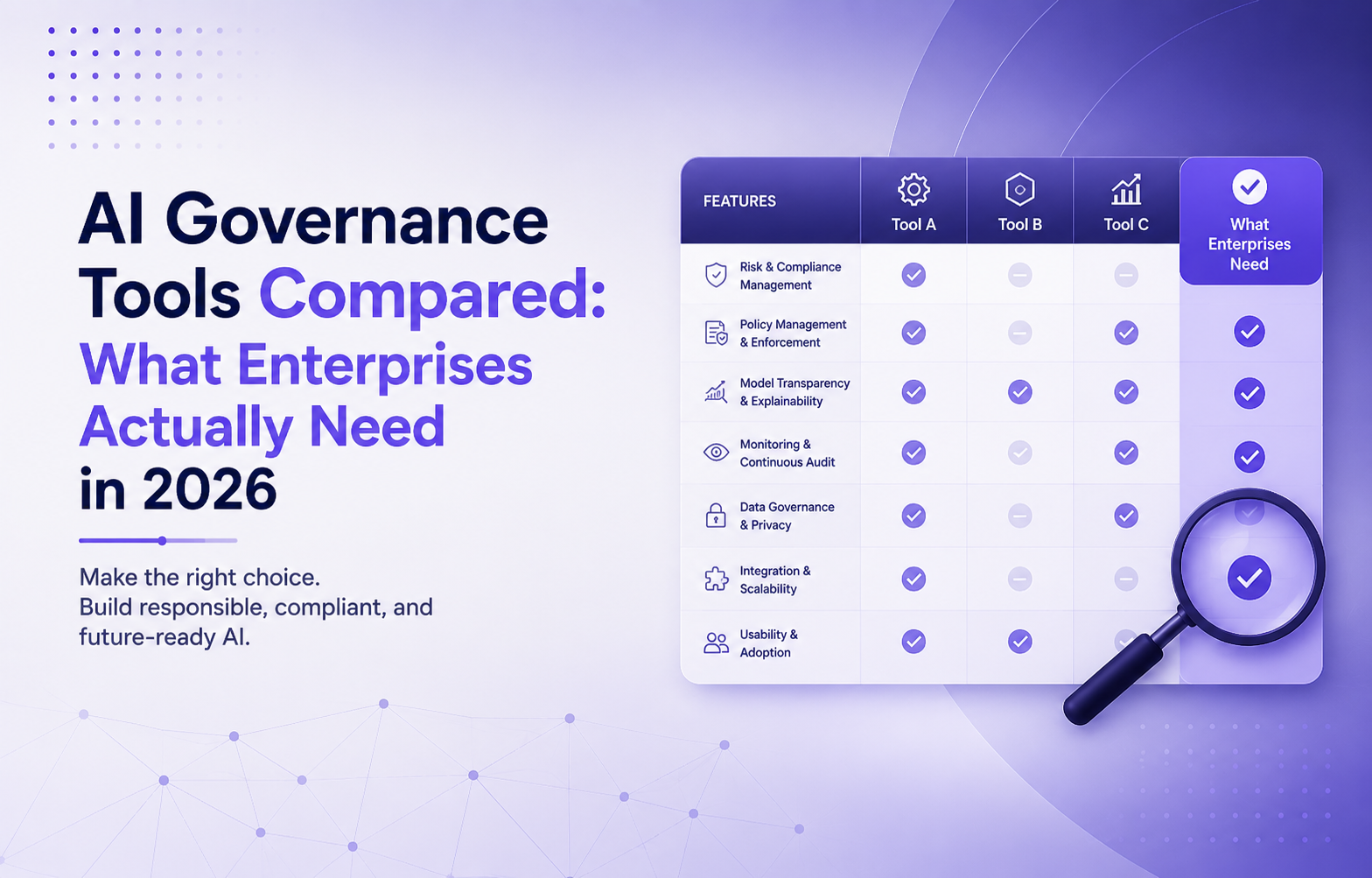
Choosing an AI governance platform should begin with understanding how AI is actually governed within your organization, not with a product demo or a feature comparison sheet. Every enterprise has its own governance processes, risk profile, and regulatory obligations. Some organizations manage AI requests through procurement, while others rely on legal, security, IT, or business operations. The right platform should align with these existing workflows and make governance easier rather than adding another layer of complexity.
Another important consideration is the deployment model and integration capabilities. Some organizations require cloud-first solutions for speed and scalability, while others need hybrid or on-premises deployments to meet security and data residency requirements. Equally important is the platform's ability to integrate with identity management systems, ticketing platforms, collaboration tools, documentation systems, and existing business applications. Without strong integrations, governance quickly becomes fragmented and heavily dependent on manual processes.
Organizations should also evaluate whether a platform supports both internally developed AI models and third-party AI solutions. Today, many enterprises rely on AI-powered SaaS applications, copilots, and embedded AI features alongside custom-built models. A governance platform should provide visibility and oversight across all AI technologies instead of focusing on only one type of deployment.
Workflow flexibility is another key factor. AI governance is rarely a one-size-fits-all process. Different departments, business units, and risk levels require different approval paths and review processes. A strong platform allows organizations to configure workflows based on the type of AI use case, regulatory requirements, and business impact while keeping governance efficient and consistent.
Finally, organizations should assess how well a platform captures governance evidence. Effective AI governance depends on maintaining a complete record of approvals, policy acknowledgements, risk assessments, review decisions, incidents, and supporting documentation. Platforms that automatically collect this information throughout the workflow simplify compliance reporting and provide a clear audit trail whenever regulators or internal stakeholders require evidence.
What Large Enterprises Should Prioritize
Large enterprises typically require a more sophisticated governance framework because AI initiatives are spread across multiple business units, regions, and regulatory environments. Their governance platforms should support federated governance, allowing organizations to maintain global standards while accommodating local policies, compliance obligations, and approval processes. Strong audit capabilities, vendor governance, and multi-level approval workflows are also essential for managing AI at enterprise scale.
Another priority for large organizations is distributed ownership. AI governance rarely belongs to a single department. Legal, IT, security, procurement, risk, compliance, and business teams all contribute to governance decisions. The platform should enable seamless collaboration, assign clear ownership, and maintain accountability across every stage of the AI lifecycle.
What Mid-Market Organizations Should Prioritize
Mid-market organizations often have different priorities. Rather than implementing highly customized governance programmes, they typically benefit from platforms that are easy to deploy, intuitive to use, and equipped with practical out-of-the-box workflows. Simpler approval processes and automated governance features allow smaller legal, IT, and security teams to manage AI effectively without creating unnecessary administrative overhead.
Most importantly, organizations should choose an AI governance platform based on the level of AI risk they face rather than company size alone. A mid-sized healthcare provider or financial institution may require stronger governance controls than a much larger organization using AI only for internal productivity. The best platform is one that aligns with the organization's AI maturity, regulatory requirements, and long-term adoption strategy while remaining practical enough to be used consistently across the business.
Red Flags to Watch for When Evaluating AI Governance Tools
Not every AI governance platform is designed to support enterprise-scale governance. While many solutions offer policy libraries, dashboards, and compliance reporting, they may fall short when it comes to managing AI within day-to-day business operations. Identifying these warning signs early can help organizations avoid investing in platforms that appear comprehensive during demonstrations but struggle in real-world environments.
Policy Management Without Workflow Execution
A platform that only stores policies and checklists provides limited value. Effective AI governance requires policies to trigger approvals, assign responsibilities, collect evidence, and guide teams through governance workflows rather than simply documenting requirements.
Poor Integration Capabilities
Governance becomes inefficient when teams must switch between disconnected systems. The platform should integrate seamlessly with identity management, procurement, ticketing, documentation, and collaboration tools to reduce manual work and improve consistency.
Inadequate Audit Trails
Comprehensive audit logs are essential for demonstrating accountability. Organizations should be able to trace approvals, policy updates, exceptions, incidents, and review decisions with complete transparency whenever required.
Unclear Risk Scoring
Risk ratings are only useful when they are transparent and actionable. If users cannot understand how a risk score is calculated or what actions it should trigger, decision-making becomes inconsistent and difficult to trust.
Limited Support for Third-Party AI
Many organizations rely heavily on external AI applications, SaaS copilots, and embedded AI features. Governance platforms should provide visibility and oversight across both internally developed models and third-party AI solutions.
Weak Collaboration Features
AI governance involves multiple stakeholders, including legal, IT, security, procurement, compliance, and business teams. Without shared workflows, task assignments, comments, and documented discussions, collaboration becomes fragmented and governance slows down.
Dashboards Without Actionable Workflows
Dashboards should do more than display metrics. The best platforms translate governance insights into assigned actions, deadlines, escalations, and remediation tasks that help organizations continuously improve their AI governance programme.
Ultimately, the goal is not to find a platform with the longest list of features, but one that performs reliably under the demands of real enterprise collaboration. A strong AI governance platform should make governance easier to execute, easier to monitor, and easier to demonstrate as AI adoption continues to scale.
Practical buying checklist for choosing the best tools for managing AI governance in workflows
The best tools for managing AI governance in workflows are usually the ones that fit the buyer’s actual operating habits. Start by identifying all current AI use cases, including unofficial ones, because shadow adoption often reveals the biggest governance gaps. Then map the stakeholders involved in review, approval, monitoring, and escalation, since workflow design depends on who must participate and when.
Next, define risk tiers that are simple enough to use in practice. If every request goes through the same heavyweight process, teams will avoid the system. Buyers should also test workflow automation directly during evaluation, not just review slideware. Ask vendors to show how a real AI intake request moves from submission to approval, evidence capture, exception handling, and incident response.
Evidence capture should be verified just as closely. Can the system preserve decisions, linked documents, comments, timestamps, and approvals in one place? Can it integrate with collaboration systems where teams already discuss risks and next steps? Finally, buyers should decide who will own governance after rollout. A platform does not solve the ownership problem by itself, but it can make that ownership visible and manageable.
Conclusion: Enterprises need AI governance that is operational, not just theoretical
As AI adoption accelerates across the enterprise, governance can no longer exist as a set of policies stored in documents or reviewed once a year. Effective AI governance must be operational, embedded into the everyday workflows where AI is requested, approved, deployed, monitored, and reviewed. The most valuable AI governance platforms are those that combine policy management, risk oversight, compliance evidence, and workflow automation into a single operating layer that supports responsible AI adoption without slowing innovation.
When evaluating AI governance platforms, enterprises should look beyond feature lists and dashboards. The real measure of success is whether the platform enables legal, IT, security, procurement, risk, and business teams to collaborate efficiently, maintain accountability, and generate audit-ready evidence throughout the AI lifecycle. Governance that is integrated into day-to-day operations is far more effective than governance that exists only on paper.
See how to operationalize AI governance across team workflows
If you are evaluating AI governance tools for 2026, do not stop at policy checklists. Review how your teams actually approve, document, monitor, and escalate AI use today, then explore how TeamSync can help turn those governance steps into consistent, audit-ready workflows across the business.