On this page
- Why Traditional AI Governance Frameworks Are Already Showing Their Limits
- What Makes AI Governance "Contextual"?
- Layer One: Start With Business Context
- Layer Two: Assess Risk Before Applying Controls
- Layer Three: Make Accountability Impossible to Ignore
- Layer Four: Build Strategic Visibility Across the Enterprise
- Layer Five: Design Governance for Continuous Adaptation
- Turning the Framework Into an AI Contextual Governance Solution
- How TeamSync Helps Organizations Govern AI at Scale
- Conclusion
AI adoption has moved from experimentation to enterprise reality faster than almost anyone predicted. According to McKinsey's 2025 State of AI survey, 88% of organizations now use AI in at least one business function. Yet despite widespread adoption, nearly two-thirds of companies are still struggling to move beyond pilots and isolated use cases into organization-wide transformation.
That gap tells an important story.
The challenge facing enterprises today is no longer access to AI; the technology is already embedded across the business. Teams are using AI to create content, automate workflows, analyze data, and support decision-making at an unprecedented scale. What is missing, however, is governance. As AI adoption accelerates, leadership teams are finding themselves responsible for systems they cannot fully monitor or control. From marketing teams generating customer-facing content to HR departments experimenting with AI-assisted hiring and finance teams leveraging predictive models, every use case introduces both opportunities and risks.
This is why AI transformation is increasingly becoming a governance challenge rather than a technology challenge. The question is no longer whether organizations should adopt AI; it is whether they can govern it effectively as adoption expands across the enterprise. Doing so requires an AI contextual governance framework, one that aligns oversight, accountability, and risk management with the specific business context of each AI use case. For organizations that take compliance seriously, platforms like TeamSync help operationalize this approach by providing the visibility, accountability, and governance controls needed to scale AI responsibly without slowing innovation.
Why Traditional AI Governance Frameworks Are Already Showing Their Limits
1. AI Use Cases Evolve Faster Than Policies
Traditional governance frameworks were built for technologies with predictable functions and clearly defined boundaries. AI is different. Employees continuously discover new ways to use AI across workflows, making it difficult for static policies to keep pace. A governance framework that isn't designed to adapt can quickly become outdated.
2. AI Impacts Multiple Business Functions
Unlike most enterprise software, AI isn't confined to a single department. It can influence marketing campaigns, hiring decisions, financial forecasting, customer interactions, and more. Because each function carries different risks and compliance requirements, a one-size-fits-all governance approach often falls short.
3. AI Creates New and Evolving Risks
AI systems don't always behave in predictable ways. Outputs can vary based on prompts, data sources, and changing models, creating risks related to accuracy, bias, security, and accountability. Governance frameworks must therefore be flexible enough to address risks that may emerge long after deployment.
4. Traditional Oversight Lacks Real-Time Visibility
Many organizations still rely on periodic audits and annual policy reviews to manage technology risks. However, AI adoption moves far more quickly. Without continuous visibility into how AI tools are being used across the enterprise, leadership teams may struggle to identify governance gaps until they become compliance or operational issues.
What Makes AI Governance "Contextual"?
The concept of contextual governance has become increasingly important because organizations are realizing that not all AI systems create the same level of risk. A marketing team using AI to generate blog drafts, social media captions, or campaign ideas operates in a completely different environment from a healthcare provider using AI to support clinical decisions. While both involve AI, the consequences of failure are vastly different. One may result in a poorly written piece of content, while the other could influence patient care. Yet many organizations continue to apply the same governance standards across all AI initiatives, creating either unnecessary restrictions or significant oversight gaps.
The problem becomes even more complex as AI adoption expands across the enterprise. Unlike traditional software, AI tools are highly adaptable and can quickly move beyond their original purpose. An AI application initially introduced to improve productivity may eventually become part of customer-facing interactions, operational workflows, or decision-making processes. As business needs evolve, so do the risks associated with these systems. Governance frameworks that rely on static rules often struggle to keep pace, leaving organizations with policies that no longer reflect how AI is actually being used.
This is why contextual governance is less about enforcing uniform controls and more about applying the right level of oversight to the right use cases. The sensitivity of the data involved, the business impact of the AI system, and the potential consequences of errors should all influence governance requirements. High-risk applications may require rigorous monitoring, documentation, and human oversight, while lower-risk tools can operate with lighter controls. By aligning governance with business context, organizations can protect against risk without slowing innovation, creating a framework that evolves alongside both the technology and the business itself.
Layer One: Start With Business Context
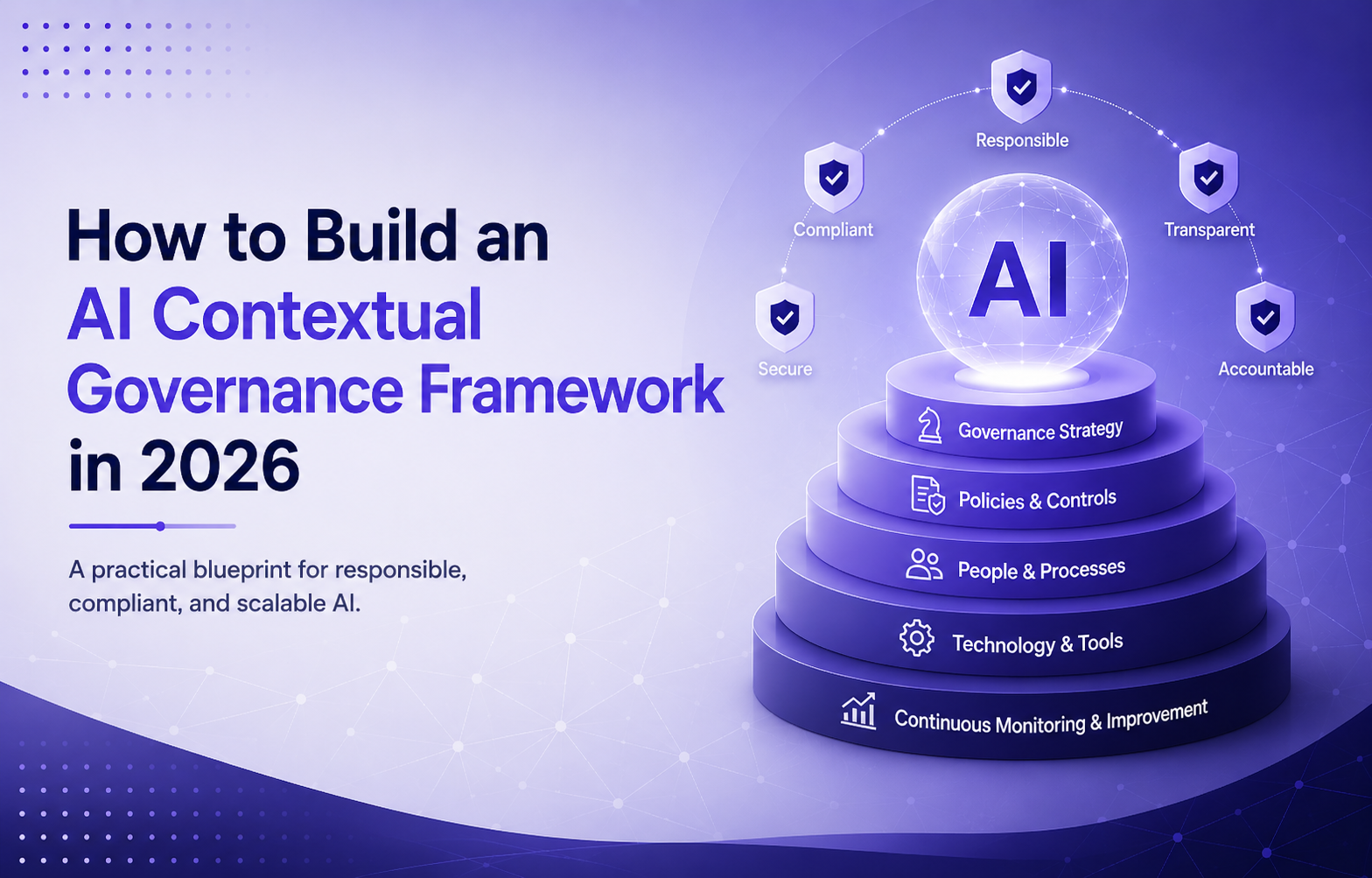
Every successful AI contextual governance framework begins with understanding the business context behind an AI use case. Before defining policies or controls, organizations need to identify what the AI system does, who uses it, what data it accesses, and how its outputs influence decisions. A content-generation tool used by marketing requires different governance than an AI system used for loan approvals or healthcare recommendations. Without context, governance becomes generic, and generic governance rarely works.
Layer Two: Assess Risk Before Applying Controls
Once the context is clear, organizations can evaluate risk more effectively. Not every AI application deserves the same level of oversight. Low-risk tools may require basic guidelines, while AI systems that influence hiring, compliance, finance, or customer outcomes demand stronger controls. A risk-based approach ensures governance supports innovation while protecting the business. This balance is central to AI contextual governance business evolution and adaptation, allowing organizations to scale AI responsibly as use cases expand.
Layer Three: Make Accountability Impossible to Ignore
One of the biggest governance failures occurs when responsibility is unclear. AI initiatives often involve multiple stakeholders, including IT, legal, compliance, and business teams. Without clearly defined ownership, governance becomes fragmented. Every AI system should have accountable owners responsible for performance, risk management, and compliance. Strong accountability transforms governance from a policy exercise into an operational capability that supports sustainable AI adoption.
Layer Four: Build Strategic Visibility Across the Enterprise
Organizations cannot govern what they cannot see. As AI adoption spreads across departments, leadership needs visibility into where AI is being used, what risks are emerging, and how governance controls are performing. This is where AI contextual governance strategic visibility becomes critical. By creating a clear view of AI usage and impact across the enterprise, organizations can identify governance gaps early and make informed decisions before risks escalate.
Layer Five: Design Governance for Continuous Adaptation
AI technology, regulations, and business priorities are constantly evolving. A governance framework that works today may require updates tomorrow. That's why governance should be treated as an ongoing capability rather than a one-time project. Organizations that embrace AI contextual governance business evolution adaptation continuously review policies, assess emerging risks, and refine controls as AI use cases mature. This adaptability enables businesses to innovate with confidence while remaining compliant and resilient.
Turning the Framework Into an AI Contextual Governance Solution
Building an AI contextual governance framework is an important first step, but creating a framework and implementing it successfully are two very different challenges. Most organizations don't struggle with defining governance principles; they struggle with embedding those principles into everyday operations. Policies can be documented, responsibilities can be assigned, and risk categories can be defined, but maintaining visibility, consistency, and accountability across multiple teams, departments, and AI use cases requires a far more structured approach.
This is where an AI contextual governance solution becomes essential. Rather than treating governance as a periodic compliance exercise, organizations need systems that make governance part of daily decision-making. Teams should be able to understand how AI is being used, identify emerging risks, monitor compliance requirements, and apply the right controls based on business context. As AI adoption continues to expand, governance must become scalable, repeatable, and adaptable enough to evolve alongside the business.
Ultimately, effective governance isn't about adding bureaucracy or slowing innovation. It's about creating the operational foundation that allows organizations to innovate confidently. By combining governance principles with AI contextual governance strategic visibility, enterprises can move beyond static policies and build a governance model that supports growth, accountability, and long-term compliance at scale.
How TeamSync Helps Organizations Govern AI at Scale
Most enterprises are not struggling because they lack AI tools. They are struggling because they lack a clear system for governing how those tools are used across the business. TeamSync helps close that gap by giving organizations the visibility, accountability, and audit readiness needed to manage AI responsibly at scale. Instead of relying on static policies, manual reviews, or disconnected approval processes, teams can create a governance layer that supports real-world AI adoption across departments. For organizations that take compliance seriously, TeamSync helps ensure AI is not just adopted quickly, but governed with the structure, oversight, and confidence required to scale responsibly.
Conclusion
The future of AI won't be determined by which organization adopts the most tools or gains access to the most advanced models. Those advantages are becoming increasingly accessible to everyone. The real differentiator will be governance. As AI becomes embedded in business operations, customer experiences, and critical decision-making processes, organizations need frameworks that evolve alongside the technology. An effective AI contextual governance framework enables businesses to balance innovation with accountability, ensuring that growth does not come at the expense of compliance or trust. The organizations that succeed in the AI era will not be those that move the fastest, but those that build the governance foundations needed to scale AI responsibly, confidently, and sustainably.