On this page
- What business-specific AI governance actually means
- Why generic policies fail to deliver business-specific accuracy
- The 7 building blocks of contextual AI governance
- How to map AI governance to actual team workflows
- Measuring business-specific contextual accuracy over time
- Common implementation mistakes and how to avoid them
- A practical roadmap for moving from generic policy to contextual governance
- Conclusion: Context is the real foundation of effective AI governance
- Build governance where work actually happens
Enterprise AI is no longer a pilot-only conversation. IBM reported that 42% of enterprise-scale organizations surveyed were already actively using AI in their business, while its 2024 research also identified limited AI skills and expertise as a top challenge for 33% of companies. At the same time, McKinsey’s 2025 global survey found that AI use is widening, but moving from experimentation to scaled impact remains difficult, and inaccuracy is the AI-related risk organizations most often say they have experienced and are working to mitigate. These signals point to the same reality: adoption is rising faster than many companies’ ability to govern AI in ways that match actual work. IBM and IBM, McKinsey.
That is where generic AI governance starts to break down. Many organizations still rely on broad acceptable-use statements, legal review language, and centralized approvals that say what employees should not do, but say little about how AI should behave inside a project update, a customer handoff, or a knowledge search. The result is a dangerous gap between policy and practice.
The organizations that close that gap will build governance around business context. This article explains what that means, why generic policies fail to deliver business-specific accuracy, and how to create an operational framework that aligns AI with real workflows, data boundaries, decision rules, and team collaboration patterns.
What business-specific AI governance actually means
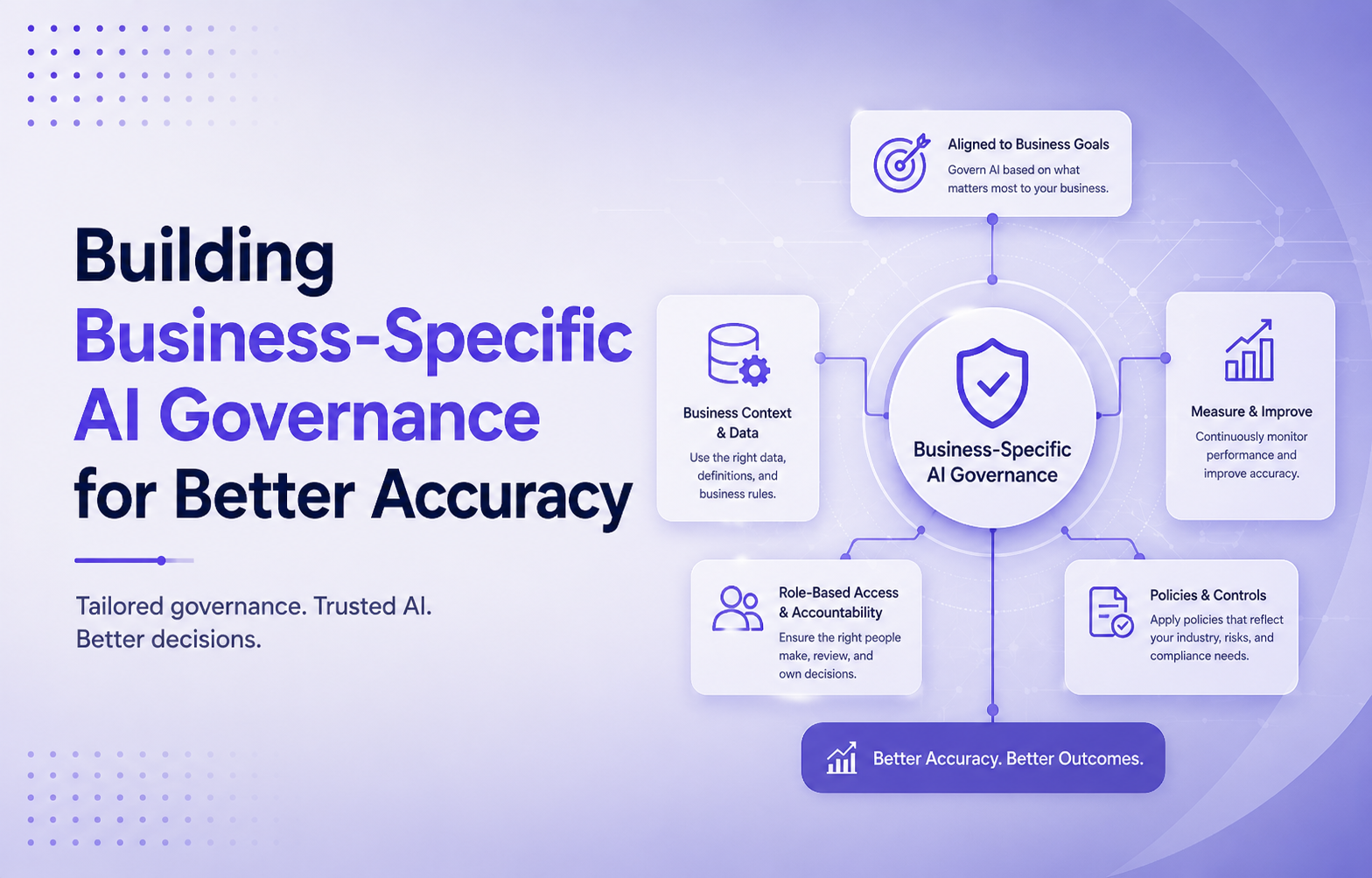
In plain language, AI governance business context means shaping AI behavior around how your business actually works. It means defining not only what is allowed, but what is correct, useful, timely, sensitive, and decision-ready inside specific workflows.
That is a broader concept than compliance alone. Compliance asks whether a system follows laws, policies, and controls. Governance in a business-specific sense asks whether the AI operates in a way that reflects your terminology, your approval logic, your risk tolerance, your source hierarchy, and your team responsibilities.
This is the difference between generic guardrails and business-specific contextual intelligence. Generic guardrails might say, “Do not enter confidential data into unapproved systems,” or “Human review is required for high-risk outputs.” Those are necessary rules, but they do not tell an AI assistant which project plan is the current one, which team owns final sign-off, which client commitments override draft timelines, or which meeting notes should be treated as authoritative.
Consider a collaboration-heavy project planning function. A generic AI assistant can summarize a planning meeting and produce a clean list of action items. But a business-governed AI assistant knows that “launch ready” means legal review is complete, the sales enablement deck is approved, and customer support macros are published. It knows that product operations owns milestone reconciliation, not product marketing. It knows that draft timelines in a side document should not override the timeline stored in the approved project workspace. That is what contextual accuracy looks like.
Why generic policies fail to deliver business-specific accuracy
Most one-size-fits-all governance fails because it treats risk as universal while work is highly specific. A policy can forbid unsafe behavior and still allow operationally wrong behavior. That is the central problem in AI governance: business-specific accuracy.
Generic rules rarely capture domain nuance. They do not understand that the same term may mean different things in finance, HR, support, and operations. They do not distinguish between a final playbook and a superseded draft. They do not account for local vocabulary, handoff rules, exception paths, or team-specific responsibilities. So even when safety controls exist, accuracy can still fail inside the workflow.
This is where ai governance contextual business reality becomes critical. In real companies, errors often emerge from missing context rather than malicious use. An AI meeting assistant may summarize the wrong action items because it cannot tell brainstorming from approved decisions. A knowledge assistant may surface outdated onboarding documents because freshness rules are not part of retrieval governance. A workflow assistant may apply the wrong approval logic because it assumes every budget request follows the same chain of command, when regional teams or business units have different thresholds.
The damage is subtle but expensive. Teams spend time checking outputs, correcting task assignments, reopening decisions, and clarifying who owns what. Trust drops. Adoption stalls. Employees start avoiding the tool for work that matters most, which means AI ends up used for low-stakes drafting instead of high-value coordination.
Better governance solves this by moving from generic restriction to contextual alignment. Instead of only asking, “Is this use allowed?”, organizations also ask, “What does accurate output look like in this workflow, for this team, using these sources, under these responsibilities?”
The 7 building blocks of contextual AI governance
If organizations want business-specific contextual accuracy, they need a framework that is structured enough to scale and specific enough to match daily operations.
Business objective mapping. Start by defining why AI is being used in the first place. A meeting summary tool, for example, may exist to reduce admin time, speed follow-up, and improve handoff reliability. Governance should reflect those objectives. If the business goal is cross-team coordination, then controls must prioritize action-item correctness, owner clarity, and timeline consistency, not just content safety.
Workflow and use case classification. Not every AI use case deserves the same control design. Drafting an internal brainstorm carries different risk from generating executive status updates or recommending customer next steps. Classifying workflows by impact, sensitivity, and decision relevance helps teams apply the right governance depth to the right use cases.
Data and knowledge source controls. AI quality depends heavily on what it can access and what it treats as authoritative. Teams should define approved knowledge sources, freshness requirements, document hierarchy, and exclusion rules. In a collaboration platform, that might mean prioritizing current project spaces over archived folders, and approved playbooks over informal chat threads.
Role-based access and responsibility design. Governance needs clear ownership. Different roles should have different access, approval rights, and accountability obligations. A department lead may approve AI-generated project recommendations, while an individual contributor may only draft them. This supports business-specific accuracy because the AI’s outputs stay aligned with how responsibility actually works.
Accuracy thresholds and escalation rules. Some workflows can tolerate rough drafts. Others cannot tolerate ambiguity. Teams should define acceptable error ranges, confidence triggers, and escalation paths. If an AI assistant is uncertain about a task owner or source document, it should route for review instead of guessing.
Monitoring and feedback loops. Governance is not complete at launch. Teams need ongoing signals about where outputs fail, where users override suggestions, and where trust is dropping. Cross-functional review loops help operations, IT, compliance, and business teams refine controls using actual usage patterns rather than assumptions.
Documentation and change management. Context changes. Teams reorganize, terminology evolves, workflows shift, and knowledge bases grow. Governance must include documented decisions, revision history, user communication, and training updates so controls remain aligned with current operations instead of last quarter’s reality.
These seven building blocks are what turn abstract rules into a living system for contextual governance.
How to map AI governance to actual team workflows
Once the framework exists, execution begins with workflow mapping. The smartest place to start is not the most visible AI feature, but the workflows where contextual accuracy matters most. In many organizations, that means meeting summaries, task assignments, project status updates, internal knowledge retrieval, and cross-team coordination.
For each workflow, teams should identify the stakeholders involved, the inputs the AI sees, the outputs it produces, the decisions those outputs influence, and the failure points that matter. An operations leader may define process steps. IT may identify integrations and access constraints. Compliance may flag sensitive data classes. Department leaders may specify acceptable output quality and review checkpoints. This is where AI governance business context refinement becomes real.
Take a project status workflow. The inputs may include meeting transcripts, task boards, prior status reports, and project documents. The output may be a weekly update shared across leadership, delivery, sales, and support. The failure points may include misstated risks, outdated milestone references, missing owner names, or action items assigned to the wrong team. Governance then maps directly onto those points. Which sources are approved? Which fields must be cited? Which roles can publish? What confidence level requires review? What happens if the AI detects conflicting timelines?
This process also forces alignment across functions. Operations defines the workflow logic. IT enforces access and integration rules. Compliance defines handling boundaries. Business leaders specify what “good enough” means for real usage. That collaboration is essential because governance that is built in isolation rarely survives contact with operational complexity.
Measuring business-specific contextual accuracy over time
Organizations often evaluate AI with generic benchmarks that say little about day-to-day usefulness. That is not enough. What matters in practice is whether the system helps teams complete work correctly, consistently, and with less rework.
The right metrics are operational. Task completion quality measures whether outputs actually support the intended workflow. Citation reliability checks whether the assistant references the right source, not just any source. Action-item correctness tests whether owners, deadlines, and dependencies are captured accurately. Document relevance measures whether retrieved content reflects the latest authoritative material. Exception rate, escalation frequency, and rework reduction reveal whether the governance model is helping or creating friction.
User trust should also be segmented by function. A support team, a finance team, and a product operations team may experience the same assistant very differently because their context demands are different. This is where AI governance business-specific contextual intelligence becomes measurable. A technically fluent answer may still be operationally poor if it ignores the real approval path, source hierarchy, or terminology of the team using it.
That distinction between technical accuracy and operational usefulness is critical. A model can generate coherent language while still producing workflow errors. Governance maturity means measuring the latter, then refining controls accordingly.
Common implementation mistakes and how to avoid them
The most common governance failure is treating all AI use cases as equal. A lightweight drafting assistant and a workflow agent that routes approvals should not sit under the same control assumptions. The correction is to tier use cases by sensitivity, business impact, and decision consequence.
Another mistake is over-centralizing governance. Central standards are necessary, but if every refinement has to route through a distant approval body, controls lag behind changing workflows. The correction is a federated model, central policy with local workflow ownership and clear escalation rules.
A third mistake is ignoring frontline feedback. Teams closest to the work often see the first signs of poor document relevance, incorrect summaries, or broken routing logic. The correction is to make override patterns, user flags, and team review sessions part of governance, not an afterthought.
A fourth mistake is failing to define accuracy thresholds. Without agreed standards, teams argue about whether outputs are “good enough” after problems appear. The correction is to define in advance what error rates, confidence levels, and review requirements are acceptable for each workflow.
A fifth mistake is separating policy from tooling. If the policy says AI must use approved sources, but the platform does not technically enforce that rule, the governance model is incomplete. The correction is to embed controls inside collaboration environments, knowledge access, and workflow logic.
A final mistake is failing to update controls as workflows evolve. Reorganizations, new product lines, and new repositories can break previously sound governance. The correction is scheduled review cycles tied to operational change, not just annual policy refreshes.
A practical roadmap for moving from generic policy to contextual governance
A practical roadmap starts with assessment. Review your current AI policies and ask whether they describe actual workflows, source boundaries, role responsibilities, and output quality requirements, or whether they remain mostly generic and legalistic. Most organizations discover that their policy posture is stronger than their operating posture.
Next, prioritize a small set of workflow-specific use cases where contextual accuracy matters most. Focus on work that is repetitive, cross-functional, and visible enough to produce measurable value, such as meeting summaries, status reporting, or internal knowledge search. This keeps the effort grounded in AI governance and contextual business reality instead of abstract maturity models.
Then define the context requirements for each use case. Specify authoritative sources, terminology, user roles, sensitivity labels, acceptable error thresholds, and escalation triggers. This is the design layer that converts business knowledge into governance logic.
After that, implement controls inside the environments where collaboration already happens. Apply role-based permissions, approved retrieval sources, structured prompt templates, audit trails, and review checkpoints where teams actually coordinate work. Governance adoption is far easier when it lives inside daily systems rather than outside them.
Measure outcomes next. Track quality, rework, exception rates, document relevance, review burden, and trust by team or function. Use those signals to identify where controls are helping, where they are too loose, and where they are too rigid.
Finally, iterate. Contextual governance is not a one-time deployment. It is a refinement cycle that should evolve with team structures, business priorities, and AI capabilities. Organizations that treat governance as an operating discipline will move faster and more safely than those that treat it as a static approval exercise.
Conclusion: Context is the real foundation of effective AI governance
AI governance becomes effective only when it reflects how a business actually works. Generic policy language can establish baseline rules, but it cannot by itself produce accurate summaries, reliable knowledge retrieval, correct approvals, or trustworthy collaboration outcomes.
Contextual accuracy comes from aligning models, prompts, data access, permissions, source hierarchy, review logic, and workflow ownership with business reality. That is the real shift from generic governance to operational governance. It is also the difference between AI that sounds helpful and AI that is actually dependable.
As AI becomes more embedded in everyday collaboration, governance maturity will increasingly determine whether organizations gain speed with control or create scale with confusion. The businesses that win will be the ones that operationalize context, not just policy.
Build governance where work actually happens
Audit your current AI policies against real team workflows, then explore how TeamSync can help you centralize collaboration, clarify responsibilities, and operationalize business-specific AI governance with the context your teams need to work accurately and confidently.
TeamSync helps organizations turn AI governance from a set of policies into a practical, day-to-day process. It centralizes AI use cases, automates approvals, tracks ownership, and maintains audit-ready records, enabling enterprises to scale AI with confidence while staying compliant.